


Page 205 - Advanced Gas Turbine Cycles
P. 205
170                        Advanced gas turbine cycles

          9.2.2. Artijicial thermal eflciency

            A second criterion of performance sometimes used is an ‘artificial’ thermal efficiency
          (vA) in which the energy in the fuel supply to the CHP plant is supposed to be reduced by
          that which would be required to produce the heat load (eu) in a separate ‘heat only’ boiler
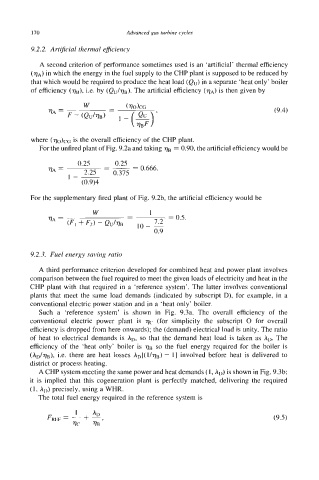
          of efficiency (VB), i.e. by (QU/vB).  The artificial efficiency (vA) is then given by


                                                                              (9.4)


          where       is the overall efficiency of the CHP plant.
            For the unfired plant of Fig. 9.2a and taking 178 = 0.90, the artificial efficiency would be

                       0.25      0.25
                              --
               7)A  =    2.25   -  0.375   = 0.666.
                    I--
                        (0.9)4
          For the supplementary fired plant of Fig. 9.2b, the artificial efficiency would be


          9.2.3. Fuel  energy saving ratio

            A third performance criterion developed for combined heat and power plant involves
          comparison between the fuel required to meet the given loads of electricity and heat in the
          CHP plant with  that required in a  ‘reference system’. The latter involves conventional
          plants that  meet the same load demands (indicated by  subscript D), for example, in  a
          conventional electric power station and in a ‘heat only’ boiler.
            Such  a  ‘reference  system’  is  shown  in  Fig.  9.3a.  The  overall  efficiency  of  the
          conventional  electric  power  plant  is  7)c  (for  simplicity  the  subscript  0 for  overall
          efficiency is dropped from here onwards); the (demand) electrical load is unity. The ratio
          of  heat  to electrical demands is AD,  so that the demand heat load is taken as AD. The
          efficiency of  the  ‘heat only’ boiler is vB so the fuel  energy required for the boiler is
          (AD/%),  i.e.  there are heat  losses AD[(l/vB) - 11 involved before heat  is delivered to
          district or process heating.
            A CHP system meeting the same power and heat demands (1, AD) is shown in Fig. 9.3b;
          it is  implied that  this cogeneration plant  is perfectly  matched, delivering the required
          (1,  AD)  precisely, using a WHR.
            The total fuel energy required in the reference system is

