


Page 243 - Advances In Productive, Safe, and Responsible Coal Mining
P. 243
222                          Advances in Productive, Safe, and Responsible Coal Mining


             Cutting bits    Mounting plate               Helical vanes


                                          Face                      Discharge
                                           side                       side


            Face ring                Bit holders               Cylindrical body

         Fig. 12.2 Drawings of a longwall-cutting drum showing its various components.

         12.4.1.1 Noise source identification
         Although the cutting drums were found to be the dominant sound-radiating compo-
         nents on a longwall shearer, it was not clear what components of the drums were radi-
         ating most of the noise. To identify these components, a panel contribution analysis
         was performed using the boundary element model and dividing it into two parts: the
         cylindrical shell and the vanes. During this analysis, only one of these parts is assumed
         flexible while the other is set to be rigid. Analysis results indicated that the four vanes
         are the critical components of the drum that generate noise of much higher amplitude
         as compared with the noise generated by the cylindrical shell [19]. However, because
         of the large dimensions of the vanes, more detailed information was needed.
            In order to gain a better understanding of the critical sound-radiating components
         on the drum, a further panel contribution analysis was performed. In this analysis, the
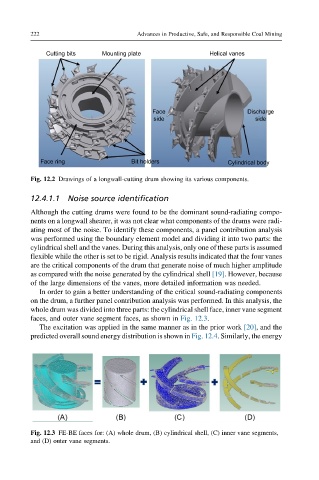
         whole drum was divided into three parts: the cylindrical shell face, inner vane segment
         faces, and outer vane segment faces, as shown in Fig. 12.3.
            The excitation was applied in the same manner as in the prior work [20], and the
         predicted overall sound energy distribution is shown in Fig. 12.4. Similarly, the energy


         Fig. 12.3 FE-BE faces for: (A) whole drum, (B) cylindrical shell, (C) inner vane segments,
         and (D) outer vane segments.

