


Page 132 - Advances in bioenergy (2016)
P. 132
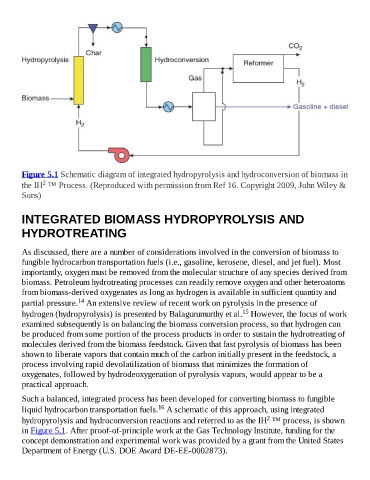
Figure 5.1 Schematic diagram of integrated hydropyrolysis and hydroconversion of biomass in
               2
        the IH  ™ Process. (Reproduced with permission from Ref 16. Copyright 2009, John Wiley &
        Sons)


        INTEGRATED BIOMASS HYDROPYROLYSIS AND

        HYDROTREATING


        As discussed, there are a number of considerations involved in the conversion of biomass to
        fungible hydrocarbon transportation fuels (i.e., gasoline, kerosene, diesel, and jet fuel). Most

        importantly, oxygen must be removed from the molecular structure of any species derived from
        biomass. Petroleum hydrotreating processes can readily remove oxygen and other heteroatoms
        from biomass-derived oxygenates as long as hydrogen is available in sufficient quantity and
                           14
        partial pressure.  An extensive review of recent work on pyrolysis in the presence of
                                                                                 15
        hydrogen (hydropyrolysis) is presented by Balagurumurthy et al.  However, the focus of work
        examined subsequently is on balancing the biomass conversion process, so that hydrogen can
        be produced from some portion of the process products in order to sustain the hydrotreating of
        molecules derived from the biomass feedstock. Given that fast pyrolysis of biomass has been
        shown to liberate vapors that contain much of the carbon initially present in the feedstock, a
        process involving rapid devolatilization of biomass that minimizes the formation of
        oxygenates, followed by hydrodeoxygenation of pyrolysis vapors, would appear to be a

        practical approach.

        Such a balanced, integrated process has been developed for converting biomass to fungible
                                                     16
        liquid hydrocarbon transportation fuels.  A schematic of this approach, using integrated
                                                                                         2
        hydropyrolysis and hydroconversion reactions and referred to as the IH  ™ process, is shown
        in Figure 5.1. After proof-of-principle work at the Gas Technology Institute, funding for the
        concept demonstration and experimental work was provided by a grant from the United States
        Department of Energy (U.S. DOE Award DE-EE-0002873).

