


Page 135 - Advances in bioenergy (2016)
P. 135
hydrocarbon product was found to remain nearly identical.

                   2
        A new IH  pilot unit, capable of continuously converting approximately 50 kg/day of feedstock,
        was designed and constructed. Beginning in 2012, Marker and others presented initial results
        of continuous, long-term testing, carried out in the 50 kg/day, continuously operated pilot
        plant. 27-31  Long-term performance of catalysts was examined, and the stability of the process
        was demonstrated over significant periods of time on stream. Earlier work had been carried
        out in the context of experiments lasting no more than a few hours, where at most a few

        kilograms of biomass were converted. As shown in Figure 5.2, continuous testing of the 50
        kg/day pilot unit has demonstrated consistent yields of liquid hydrocarbons over almost 700 of
        hours of operation.

                                                                                            2
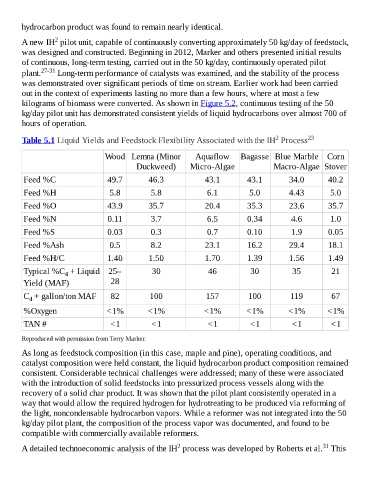
        Table 5.1 Liquid Yields and Feedstock Flexibility Associated with the IH  Process              23

                                    Wood Lemna (Minor             Aquaflow      Bagasse Blue Marble          Corn
                                              Duckweed)         Micro-Algae                Macro-Algae Stover
         Feed %C                    49.7          46.3               43.1          43.1         34.0         40.2

         Feed %H                     5.8           5.8               6.1           5.0          4.43          5.0

         Feed %O                    43.9          35.7               20.4          35.3         23.6         35.7
         Feed %N                     0.11          3.7               6.5           0.34          4.6          1.0

         Feed %S                    0.03           0.3               0.7           0.10          1.9         0.05

         Feed %Ash                   0.5           8.2               23.1          16.2         29.4         18.1

         Feed %H/C                  1.40          1.50               1.70          1.39         1.56         1.49
         Typical %C  + Liquid        25–           30                 46            30            35          21
                      4
         Yield (MAF)                  28
         C  + gallon/ton MAF          82          100                157           100           119          67
           4

         %Oxygen                    <1%           <1%               <1%           <1%           <1%          <1%
         TAN #                       <1            <1                <1            <1            <1           <1

        Reproduced with permission from Terry Marker.

        As long as feedstock composition (in this case, maple and pine), operating conditions, and
        catalyst composition were held constant, the liquid hydrocarbon product composition remained
        consistent. Considerable technical challenges were addressed; many of these were associated
        with the introduction of solid feedstocks into pressurized process vessels along with the
        recovery of a solid char product. It was shown that the pilot plant consistently operated in a
        way that would allow the required hydrogen for hydrotreating to be produced via reforming of
        the light, noncondensable hydrocarbon vapors. While a reformer was not integrated into the 50

        kg/day pilot plant, the composition of the process vapor was documented, and found to be
        compatible with commercially available reformers.

                                                                                                            31
                                                            2
        A detailed technoeconomic analysis of the IH  process was developed by Roberts et al.  This

