


Page 159 - Advances in bioenergy (2016)
P. 159
small scale (<100MW fuel input), mainly indirect atmospheric gasifiers are discussed to avoid
        the costs of the oxygen production.    6

        The choice of the gasification reactor is not easy, as it influences the whole conversion chain,
        e.g., the gas treatment has to be adjusted to the type of gasifier and the synthesis should also fit
        to the properties of the synthesis gas (e.g., H :CO ratio, amount of inerts). Up to date no single
                                                          2
        ‘winner’ has been identified and R&D on the different types of conversion chains from
        biomass to transportation fuels and chemicals is going on.


        APPLICATIONS FOR SYNTHESIS GAS FROM BIOMASS


        R&D on applications for synthesis gas from biomass was in the past decade mainly focused on
        transportation fuels and less on chemicals. Most of the R&D was done on FT, hydrogen,
        methanol (including MtG, MtD, MtO, DME), ethanol, mixed alcohols, and SNG. Therefore,
        below, there are short descriptions of the different synthesis routes.


        FT Synthesis

        The FT synthesis is based on the conversion of a mixture of carbon monoxide and hydrogen
        into liquid hydrocarbons.    7

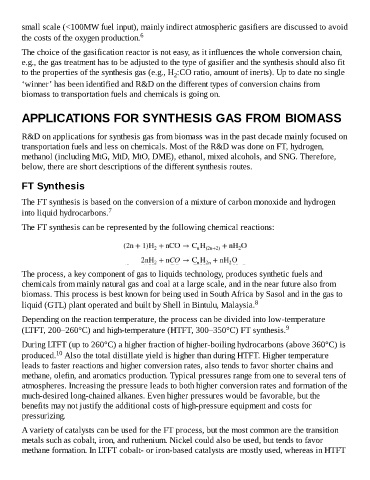
        The FT synthesis can be represented by the following chemical reactions:


        The process, a key component of gas to liquids technology, produces synthetic fuels and
        chemicals from mainly natural gas and coal at a large scale, and in the near future also from
        biomass. This process is best known for being used in South Africa by Sasol and in the gas to
        liquid (GTL) plant operated and built by Shell in Bintulu, Malaysia.         8

        Depending on the reaction temperature, the process can be divided into low-temperature
        (LTFT, 200–260°C) and high-temperature (HTFT, 300–350°C) FT synthesis.                 9

        During LTFT (up to 260°C) a higher fraction of higher-boiling hydrocarbons (above 360°C) is
                    10
        produced.  Also the total distillate yield is higher than during HTFT. Higher temperature
        leads to faster reactions and higher conversion rates, also tends to favor shorter chains and
        methane, olefin, and aromatics production. Typical pressures range from one to several tens of
        atmospheres. Increasing the pressure leads to both higher conversion rates and formation of the
        much-desired long-chained alkanes. Even higher pressures would be favorable, but the
        benefits may not justify the additional costs of high-pressure equipment and costs for
        pressurizing.

        A variety of catalysts can be used for the FT process, but the most common are the transition
        metals such as cobalt, iron, and ruthenium. Nickel could also be used, but tends to favor
        methane formation. In LTFT cobalt- or iron-based catalysts are mostly used, whereas in HTFT

