


Page 160 - Advances in bioenergy (2016)
P. 160
only iron-based catalysts are used.

        The advantage of the cobalt-based catalysts is a much longer lifetime. Less unsaturated
        hydrocarbons and alcohols are produced compared with the iron-based catalysts. On the other
        hand, iron-based catalysts are more tolerant to sulfur and can be also used to adjust the H :CO
                                                                                                             2
        ratio, if it is lower than 2 by means of water-gas shift reaction.


        Hydrogen


        Hydrogen can be produced from the gasification product gas through the steam reforming and
        water-gas shift reaction. Using a dual fluidized bed (DFB) gasification system with CO
                                                                                                           2
        adsorption along with suitable catalysts, it is possible to achieve a hydrogen yield up to 70
        vol% direct in the gasifier.   11

        Furthermore, the costs of hydrogen production by biomass gasification in very large scale are

        competitive with natural gas reforming.      12
                                                                              13
        Hydrogen is one of the most promising future energy carriers.  Therefore, it is expected that
        biomass gasification process will be available for large-scale hydrogen production.

        Series of investigations on hydrogen production methods have been conducted over the past
                           14
        several decades.  Biomass is potentially a reliable energy source for hydrogen production. It
        is renewable, abundant, easy to use, and CO  neutral.
                                                          2

        Methanol


        Methanol, also known as methyl alcohol, wood alcohol, or wood spirits, is often abbreviated
        as MeOH. It can be produced from fossil or renewable resources and can be used either
        directly as a transportation fuel or can be converted further to hydrocarbons.         15

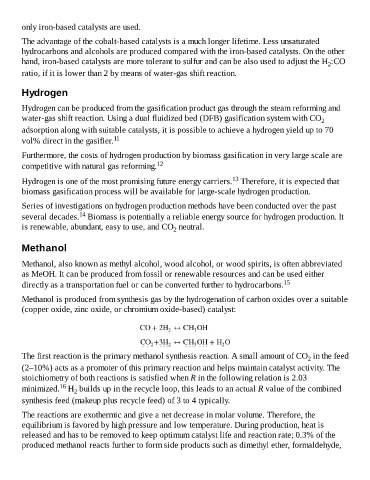
        Methanol is produced from synthesis gas by the hydrogenation of carbon oxides over a suitable
        (copper oxide, zinc oxide, or chromium oxide-based) catalyst:


        The first reaction is the primary methanol synthesis reaction. A small amount of CO  in the feed
                                                                                                       2
        (2–10%) acts as a promoter of this primary reaction and helps maintain catalyst activity. The
        stoichiometry of both reactions is satisfied when R in the following relation is 2.03
                     16
        minimized.  H  builds up in the recycle loop, this leads to an actual R value of the combined
                         2
        synthesis feed (makeup plus recycle feed) of 3 to 4 typically.

        The reactions are exothermic and give a net decrease in molar volume. Therefore, the
        equilibrium is favored by high pressure and low temperature. During production, heat is
        released and has to be removed to keep optimum catalyst life and reaction rate; 0.3% of the
        produced methanol reacts further to form side products such as dimethyl ether, formaldehyde,

