


Page 168 - Advances in bioenergy (2016)
P. 168
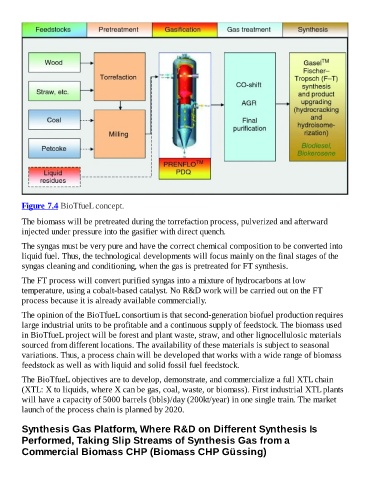
Figure 7.4 BioTfueL concept.

        The biomass will be pretreated during the torrefaction process, pulverized and afterward
        injected under pressure into the gasifier with direct quench.

        The syngas must be very pure and have the correct chemical composition to be converted into
        liquid fuel. Thus, the technological developments will focus mainly on the final stages of the
        syngas cleaning and conditioning, when the gas is pretreated for FT synthesis.

        The FT process will convert purified syngas into a mixture of hydrocarbons at low
        temperature, using a cobalt-based catalyst. No R&D work will be carried out on the FT
        process because it is already available commercially.

        The opinion of the BioTfueL consortium is that second-generation biofuel production requires
        large industrial units to be profitable and a continuous supply of feedstock. The biomass used
        in BioTfueL project will be forest and plant waste, straw, and other lignocellulosic materials
        sourced from different locations. The availability of these materials is subject to seasonal
        variations. Thus, a process chain will be developed that works with a wide range of biomass

        feedstock as well as with liquid and solid fossil fuel feedstock.

        The BioTfueL objectives are to develop, demonstrate, and commercialize a full XTL chain
        (XTL: X to liquids, where X can be gas, coal, waste, or biomass). First industrial XTL plants
        will have a capacity of 5000 barrels (bbls)/day (200kt/year) in one single train. The market
        launch of the process chain is planned by 2020.


        Synthesis Gas Platform, Where R&D on Different Synthesis Is
        Performed, Taking Slip Streams of Synthesis Gas from a
        Commercial Biomass CHP (Biomass CHP Güssing)

