


Page 172 - Advances in bioenergy (2016)
P. 172
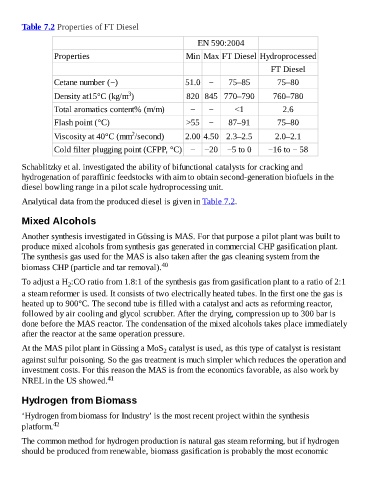
Table 7.2 Properties of FT Diesel

                                                                  EN 590:2004

                   Properties                                 Min Max FT Diesel Hydroprocessed

                                                                                          FT Diesel
                   Cetane number (−)                          51.0 −        75–85            75–80

                                           3
                   Density at15°C (kg/m )                      820 845 770–790             760–780
                   Total aromatics content% (m/m)               −     −        <1             2.6

                   Flash point (°C)                           >55     −     87–91            75–80
                                            2
                   Viscosity at 40°C (mm /second)             2.00 4.50 2.3–2.5             2.0–2.1
                   Cold filter plugging point (CFPP, °C) −           −20    −5 to 0       −16 to − 58


        Schablitzky et al. investigated the ability of bifunctional catalysts for cracking and
        hydrogenation of paraffinic feedstocks with aim to obtain second-generation biofuels in the
        diesel bowling range in a pilot scale hydroprocessing unit.

        Analytical data from the produced diesel is given in Table 7.2.


        Mixed Alcohols

        Another synthesis investigated in Güssing is MAS. For that purpose a pilot plant was built to
        produce mixed alcohols from synthesis gas generated in commercial CHP gasification plant.
        The synthesis gas used for the MAS is also taken after the gas cleaning system from the
        biomass CHP (particle and tar removal).       40

        To adjust a H :CO ratio from 1.8:1 of the synthesis gas from gasification plant to a ratio of 2:1
                       2
        a steam reformer is used. It consists of two electrically heated tubes. In the first one the gas is
        heated up to 900°C. The second tube is filled with a catalyst and acts as reforming reactor,
        followed by air cooling and glycol scrubber. After the drying, compression up to 300 bar is
        done before the MAS reactor. The condensation of the mixed alcohols takes place immediately
        after the reactor at the same operation pressure.

        At the MAS pilot plant in Güssing a MoS  catalyst is used, as this type of catalyst is resistant
                                                       2
        against sulfur poisoning. So the gas treatment is much simpler which reduces the operation and
        investment costs. For this reason the MAS is from the economics favorable, as also work by
        NREL in the US showed.       41


        Hydrogen from Biomass

        ‘Hydrogen from biomass for Industry’ is the most recent project within the synthesis
        platform.  42

        The common method for hydrogen production is natural gas steam reforming, but if hydrogen
        should be produced from renewable, biomass gasification is probably the most economic

