


Page 174 - Advances in bioenergy (2016)
P. 174
(LHV). Forty percent of the carbon of the biomass becomes part of the SNG and an equal
        amount of carbon can be captured as CO . The remaining 20% of the carbon is part of the flue
                                                      2
        gas from the process.


        Sorption-Enhanced Reforming, to Adjust the H :CO Ratio Direct
                                                                                   2
        Inside the Gasifier

        The composition of the syngas from gasification processes or syngas production technologies
        is generally not suited for direct use in the downstream synthesis system. In several cases,

        H /CO syngas ratio adjustment techniques such as downstream shift reactors, membrane
          2
        separators or pressure swing adsorption are employed to meet the ratio requirements. This
        adds costs and complexity to the overall process.

        In the sorption-enhanced reforming process, hydrocarbon reforming, water-gas shift, and CO               2
        separation reactions occur simultaneously in a single reaction step over a reforming catalyst

        mixed with a CO  sorbent. Depending on reaction conditions, the product gas may contain as
                           2
        much as 98% H  and only ppmv levels of CO and CO , thereby minimizing the final H                 2
                                                                     2
                          2
        purification process or even eliminating it for some applications.        45

        There is a number of CO  sorbents such as Ca-based oxides, HTC (hydrotreating catalysts,
                                    2
        which are double-layered hydroxides) and mixed oxides of Li and Na. Limestone and dolomite
        are the precursors for Ca-based oxides. These have the advantage of good availability and are
        not expensive. They offer high CO  capacity and react rapidly over a wide range of
                                               2
        temperatures and pressures. Their disadvantage is associated with the high temperature
        required for sorbent regeneration. High temperature promotes sorbent sintering that leads to

        rapid deactivation. Another disadvantage is the high attrition of the adsorbens, so much R&D
        was done to improve the mechanical properties.

        The concept of sorption-enhanced hydrogen production in the presence of Ca-based sorbent is
        not new. The first description of this process was published already in 1867 by DuMotay and
                                                                                                  46
        Marechal who used limestone to enhance the gasification of carbon with steam.  Later, Curran
              47
        et al.  developed the ‘CO  acceptor process’, utilizing the carbonation reaction for the
                                      2
        gasification of lignite coal to produce a H  rich gas.
                                                        2
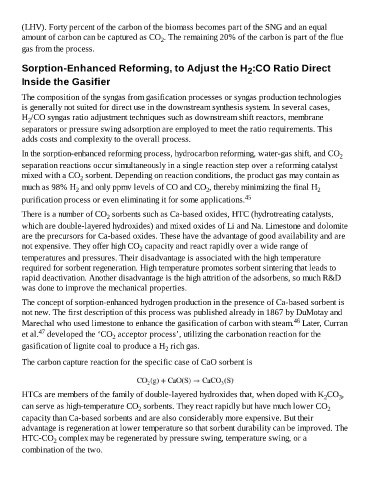
        The carbon capture reaction for the specific case of CaO sorbent is


        HTCs are members of the family of double-layered hydroxides that, when doped with K CO ,
                                                                                                            2
                                                                                                                 3
        can serve as high-temperature CO  sorbents. They react rapidly but have much lower CO                2
                                               2
        capacity than Ca-based sorbents and are also considerably more expensive. But their
        advantage is regeneration at lower temperature so that sorbent durability can be improved. The
        HTC-CO  complex may be regenerated by pressure swing, temperature swing, or a
                   2
        combination of the two.

