


Page 189 - Advances in bioenergy (2016)
P. 189
9
        exajoule/year with an energy equivalence of  76×10  barrels of oil energy equivalent.             2,4
        Lignocellulosic biomasses are obtained as nonedible residues from agriculture, forestry,
        municipal, industrial, and urban refuse. These organic residues are suitable raw material for
        biofuel production through efficient conversion technologies employing physicochemical,
        thermochemical, or biochemical routes, which have huge potential for hydrogen production and
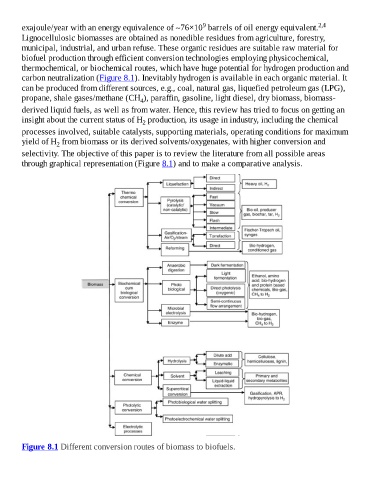
        carbon neutralization (Figure 8.1). Inevitably hydrogen is available in each organic material. It

        can be produced from different sources, e.g., coal, natural gas, liquefied petroleum gas (LPG),
        propane, shale gases/methane (CH ), paraffin, gasoline, light diesel, dry biomass, biomass-
                                               4
        derived liquid fuels, as well as from water. Hence, this review has tried to focus on getting an
        insight about the current status of H  production, its usage in industry, including the chemical
                                                2
        processes involved, suitable catalysts, supporting materials, operating conditions for maximum
        yield of H  from biomass or its derived solvents/oxygenates, with higher conversion and
                    2
        selectivity. The objective of this paper is to review the literature from all possible areas
        through graphical representation (Figure 8.1) and to make a comparative analysis.


        Figure 8.1 Different conversion routes of biomass to biofuels.

