


Page 194 - Advances in bioenergy (2016)
P. 194
14
        etc.), solvents (e.g., acetone), and alcohols (e.g., phenol, methanol etc.).  Thermochemical
        conversions are preferred because they convert solid biomass into energy-densified liquid
        products with an ease of transport, storage, combustion, and marketing.          7,10  Bio-oil is a

        synthetic fuel obtained from the pyrolysis of biomass, which contains 70% of the energy of the
        biomass feed and is a complex mixture of alcohols, acids, aldehydes, esters, ketones, and many
        other aromatic compounds.
        It is particularly important to understand the differences between slow, intermediate, fast, and

        flash pyrolysis and the factors affecting bio-oil, gas, and biochar yields. In most cases, the
        inorganic metals in biomass, particularly the alkali metals, can have a catalytic effect on
        pyrolysis reactions leading to increased biochar and producer gas yields. As reported by
        Bridgwater and Peacocke and Mohan et al. high heating rates and fine particle size of biomass
        are required for fast pyrolysis leading to rapid heat transfer from the heat source, whereas
        slow and intermediate pyrolysis produces (> 35%) higher yield of producer gas.             21-23
        Meanwhile in case of intermediate pyrolysis utilizing pyroformer, the hot volatiles may come
        in contact with unpyrolised solids and condense, followed by secondary reactions to form tars.
        Depending upon the type of reactor and feed type, the oxygen content varies typically in the
        range of (30–40%) in bio-oil and it carries a lower heating value (16–19 MJ/kg) compared

        with conventional fuel oil (40 MJ/kg). The high oxygen content of bio-oil makes it
        incompatible with petroleum-derived oils. Bio-oils are less volatile, have cold flow
        problems, are dark brown in color, chemically unstable, produce many unwanted chemical
        reactions with increasing time and temperature, leading to an increase in viscosity and cloud
        point temperature. By increasing the severity of pyrolysis conditions, feed rate, and optimized
        size of feed with low moisture content it is flexible to produce more gases (CO, H , CO , and
                                                                                                            2
                                                                                                     2
        CH ). The remaining bio-oil after condensation can then be treated further to produce
            4
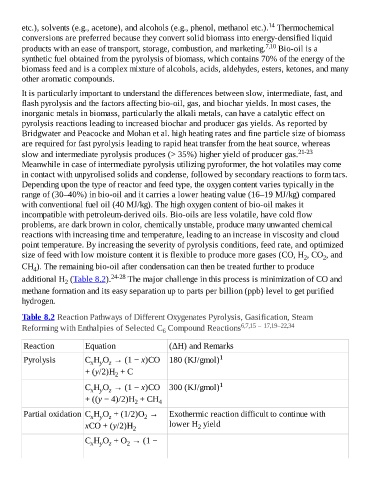
        additional H  (Table 8.2).    24-28  The major challenge in this process is minimization of CO and
                      2
        methane formation and its easy separation up to parts per billion (ppb) level to get purified
        hydrogen.


        Table 8.2 Reaction Pathways of Different Oxygenates Pyrolysis, Gasification, Steam

        Reforming with Enthalpies of Selected C  Compound Reactions              6,7,15 – 17,19–22,34
                                                       6
         Reaction            Equation                    (ΔH) and Remarks

         Pyrolysis           C H O  → (1 − x)CO          180 (KJ/gmol)    1
                               x y z
                             + (y/2)H  + C
                                       2
                             C H O  → (1 − x)CO          300 (KJ/gmol)    1
                               x y z
                             + ((y − 4)/2)H  + CH    4
                                             2
         Partial oxidation C H O  + (1/2)O  →            Exothermic reaction difficult to continue with
                                                 2
                               x y z
                             xCO + (y/2)H    2           lower H  yield
                                                                  2
                             C H O  + O  → (1 −
                                           2
                               x y z

