


Page 195 - Advances in bioenergy (2016)
P. 195
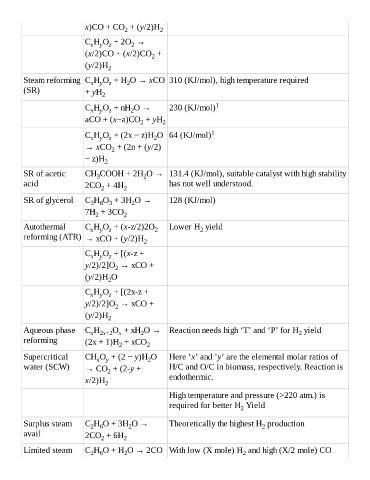
x)CO + CO  + (y/2)H      2
                                          2
                             C H O  + 2O  →
                               x y z        2
                             (x/2)CO + (x/2)CO  +
                                                   2
                             (y/2)H  2

         Steam reforming C H O  + H O → xCO 310 (KJ/mol), high temperature required
                                           2
                               x y z
         (SR)                + yH  2

                             C H O  + nH O →             230 (KJ/mol)   1
                                            2
                               x y z
                             aCO + (x−a)CO  + yH       2
                                               2
                             C H O  + (2x − z)H O 64 (KJ/mol)          1
                               x y z
                                                    2
                             → xCO  + (2n + (y/2)
                                      2
                             − z)H
                                    2
         SR of acetic        CH COOH + 2H O → 131.4 (KJ/mol), suitable catalyst with high stability
                                                2
                                 3
         acid                2CO  + 4H    2              has not well understood.
                                  2
         SR of glycerol      C H O  + 3H O →             128 (KJ/mol)
                               3 8 3
                                            2
                             7H  + 3CO    2
                                 2
         Autothermal         C H O  + (x-z/2)2O     2    Lower H  yield
                               x y z
                                                                   2
         reforming (ATR)     → xCO + (y/2)H      2

                             C H O  + [(x-z +
                               x y z
                             y/2)/2]O  → xCO +
                                       2
                             (y/2)H O
                                     2

                             C H O  + [(2x-z +
                               x y z
                             y/2)/2]O  → xCO +
                                       2
                             (y/2)H  2

         Aqueous phase       C H      O  + xH O → Reaction needs high ‘T’ and ‘P’ for H  yield
                               x 2x+2 x
                                                2
                                                                                                    2
         reforming           (2x + 1)H  + xCO     2
                                        2
         Supercritical       CH O  + (2 − y)H O          Here ’x’ and ’y’ are the elemental molar ratios of
                                 x y
                                                  2
         water (SCW)         → CO  + (2-y +              H/C and O/C in biomass, respectively. Reaction is
                                     2
                             x/2)H  2                    endothermic.

                                                         High temperature and pressure (>220 atm.) is
                                                         required for better H  Yield
                                                                                2

         Surplus steam       C H O + 3H O →              Theoretically the highest H  production
                               2 6         2                                            2
         avail               2CO  + 6H    2
                                  2
         Limited steam       C H O + H O → 2CO With low (X mole) H  and high (X/2 mole) CO
                               2 6
                                                                                 2
                                          2

