


Page 193 - Advances in bioenergy (2016)
P. 193
biodegradable, and low in toxicity; (2) they can be easily decomposed in the presence of water
        to generate a hydrogen-rich mixture; and (3) they are free from catalyst toxins such as sulfur.
        This review has emphasized on hydrogen generation via pyrolysis of biomass, gasification,
        gasification combined with pyrolysis, from supercritical water (fluid-gas) extraction. Steam
        reforming (SR), autothermal reforming (ATR), dry reforming (DR), liquid phase reforming
        (LPR), aqueous-phase reforming (APR) and partial oxidation (POX) of renewable
        carboxylates, such as bioethanol, glycerol, carbohydrates, and bio-oil are some usual
        processes to be explored for their widespread awareness. Among all these processes SR is
        endothermic, (T > 300°C); for LPR, high pressure and T < 300°C are required; for ATR, both

        partial oxidation and steam reforming in the temperature range of (550°C < T < 850°C) are
        necessary. However, supercritical reforming always occurs at high pressure and at T > 374°C,
        and to carry out photocatalytic conversion T ≈ 25°C is appropriate.          19-23

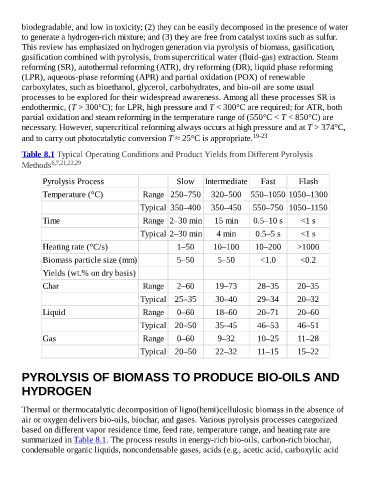
        Table 8.1 Typical Operating Conditions and Product Yields from Different Pyrolysis
        Methods   6,7,21,22,29


               Pyrolysis Process                           Slow      Intermediate      Fast         Flash
               Temperature (°C)                 Range 250–750          320–500      550–1050 1050–1300

                                               Typical 350–400         350–450       550–750 1050–1150

               Time                             Range 2–30 min          15 min       0.5–10 s       <1 s

                                               Typical 2–30 min          4 min       0.5–5 s        <1 s
               Heating rate (°C/s)                         1–50        10–100        10–200        >1000

               Biomass particle size (mm)                  5–50          5–50          <1.0         <0.2

               Yields (wt.% on dry basis)
               Char                             Range      2–60         19–73         28–35        20–35

                                               Typical 25–35            30–40         29–34        20–32

               Liquid                           Range      0–60         18–60         20–71        20–60
                                               Typical 20–50            35–45         46–53        46–51

               Gas                              Range      0–60          9–32         10–25        11–28

                                               Typical 20–50            22–32         11–15        15–22


        PYROLYSIS OF BIOMASS TO PRODUCE BIO-OILS AND

        HYDROGEN


        Thermal or thermocatalytic decomposition of ligno(hemi)cellulosic biomass in the absence of
        air or oxygen delivers bio-oils, biochar, and gases. Various pyrolysis processes categorized
        based on different vapor residence time, feed rate, temperature range, and heating rate are
        summarized in Table 8.1. The process results in energy-rich bio-oils, carbon-rich biochar,
        condensable organic liquids, noncondensable gases, acids (e.g., acetic acid, carboxylic acid

