


Page 276 - Advances in Renewable Energies and Power Technologies
P. 276
6. Fault Detection Procedures   249


                     When some fault appears in the PV array, the output current and/or the output
                  voltage are reduced. The overall decrease in the output voltage depends on the num-
                  ber of short-circuited PV modules or the number of bypass diodes activated in the
                  PV modules that form the PV array. Moreover, the number of equivalent bypassed
                  modules, BPmod, present on the PV array is estimated as follows [41]:
                                                          NRv

                                       BP mod ¼ Nsm 1                           (7.46)
                                                         NRvo
                     On the other hand it is possible to estimate the equivalent number of faulty
                  strings, Efs, in the PV array when a decrease in output current is observed using
                  the following equation [41]:

                                                        NRc
                                         Efs ¼ Npm 1                            (7.47)
                                                       NRco
                     In normal operation of the PV system the values of the indicators NRc and NRv
                  should be very close to the values of NRco and NRvo given by Eqs. (40) and (41) and
                  maintain their values over specific thresholds. When one of the values of the indica-
                  tors, NRc or NRv, is below its defined threshold, TNRcfs and TNRvbm, Eqs. (42) and
                  (43), the supervision system detects a fault in the PV array. The diagnostic of the
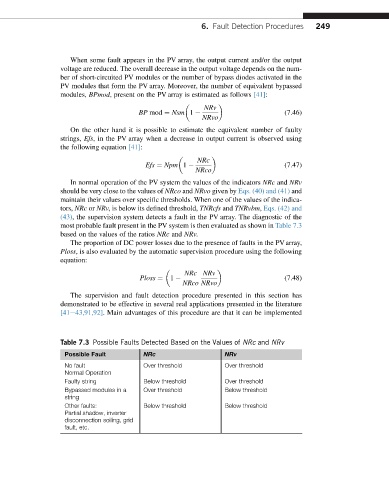
                  most probable fault present in the PV system is then evaluated as shown in Table 7.3
                  based on the values of the ratios NRc and NRv.
                     The proportion of DC power losses due to the presence of faults in the PV array,
                  Ploss, is also evaluated by the automatic supervision procedure using the following
                  equation:

                                                    NRc NRv
                                        Ploss ¼  1                              (7.48)
                                                    NRco NRvo
                     The supervision and fault detection procedure presented in this section has
                  demonstrated to be effective in several real applications presented in the literature
                  [41e43,91,92]. Main advantages of this procedure are that it can be implemented


                  Table 7.3 Possible Faults Detected Based on the Values of NRc and NRv
                   Possible Fault        NRc                   NRv
                   No fault              Over threshold        Over threshold
                   Normal Operation
                   Faulty string         Below threshold       Over threshold
                   Bypassed modules in a  Over threshold       Below threshold
                   string
                   Other faults:         Below threshold       Below threshold
                   Partial shadow, inverter
                   disconnection soiling, grid
                   fault, etc.

