


Page 388 - Advances in Renewable Energies and Power Technologies
P. 388
3. Energy Management for Photovoltaic Installations  361


                                                           R aux

                                               K 4
                               P pv
                                                K 2


                                              K 1  K 3
                               P FC


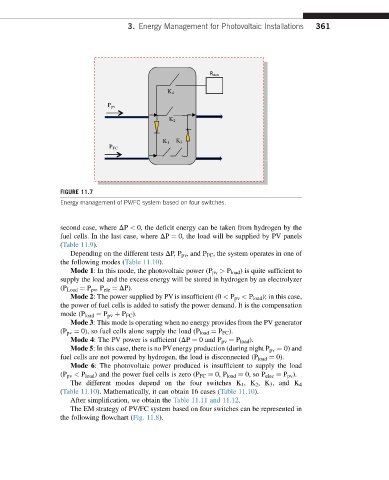
                  FIGURE 11.7
                  Energy management of PV/FC system based on four switches.


                  second case, where DP < 0, the deficit energy can be taken from hydrogen by the
                  fuel cells. In the last case, where DP ¼ 0, the load will be supplied by PV panels
                  (Table 11.9).
                     Depending on the different tests DP, P pv , and P FC , the system operates in one of
                  the following modes (Table 11.10).
                     Mode 1: In this mode, the photovoltaic power (P pv > P load ) is quite sufficient to
                  supply the load and the excess energy will be stored in hydrogen by an electrolyzer
                  (P Load ¼ P pv ,P ele ¼ DP).
                     Mode 2: The power supplied by PV is insufficient (0 < P pv < P load ); in this case,
                  the power of fuel cells is added to satisfy the power demand. It is the compensation
                  mode (P load ¼ P pv þ P FC ).
                     Mode 3: This mode is operating when no energy provides from the PV generator
                  (P pv ¼ 0), so fuel cells alone supply the load (P load ¼ P FC ).
                     Mode 4: The PV power is sufficient (DP ¼ 0 and P pv ¼ P load ).
                     Mode 5: In this case, there is no PVenergy production (during night P pv ¼ 0) and
                  fuel cells are not powered by hydrogen, the load is disconnected (P load ¼ 0).
                     Mode 6: The photovoltaic power produced is insufficient to supply the load
                  (P pv < P load ) and the power fuel cells is zero (P FC ¼ 0, P load ¼ 0, so P elec ¼ P pv ).
                     The different modes depend on the four switches K 1 ,K 2 ,K 3 , and K 4
                  (Table 11.10). Mathematically, it can obtain 16 cases (Table 11.10).
                     After simplification, we obtain the Table 11.11 and 11.12.
                     The EM strategy of PV/FC system based on four switches can be represented in
                  the following flowchart (Fig. 11.8).

