


Page 402 - Advances in Renewable Energies and Power Technologies
P. 402
1. Introduction   375


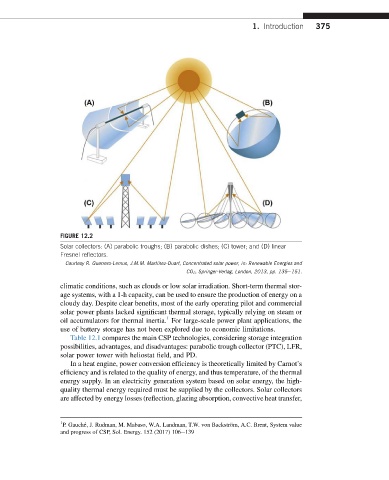
                  FIGURE 12.2
                  Solar collectors: (A) parabolic troughs; (B) parabolic dishes; (C) tower; and (D) linear
                  Fresnel reflectors.
                   Courtesy R. Guerrero-Lemus, J.M.M. Martı ´nez-Duart, Concentrated solar power, in: Renewable Energies and
                                                     CO 2 , Springer-Verlag, London, 2013, pp. 135e151.
                  climatic conditions, such as clouds or low solar irradiation. Short-term thermal stor-
                  age systems, with a 1-h capacity, can be used to ensure the production of energy on a
                  cloudy day. Despite clear benefits, most of the early operating pilot and commercial
                  solar power plants lacked significant thermal storage, typically relying on steam or
                                               1
                  oil accumulators for thermal inertia. For large-scale power plant applications, the
                  use of battery storage has not been explored due to economic limitations.
                     Table 12.1 compares the main CSP technologies, considering storage integration
                  possibilities, advantages, and disadvantages: parabolic trough collector (PTC), LFR,
                  solar power tower with heliostat field, and PD.
                     In a heat engine, power conversion efficiency is theoretically limited by Carnot’s
                  efficiency and is related to the quality of energy, and thus temperature, of the thermal
                  energy supply. In an electricity generation system based on solar energy, the high-
                  quality thermal energy required must be supplied by the collectors. Solar collectors
                  are affected by energy losses (reflection, glazing absorption, convective heat transfer,


                  1
                  P. Gauche ´, J. Rudman, M. Mabaso, W.A. Landman, T.W. von Backstro ¨m, A.C. Brent, System value
                  and progress of CSP, Sol. Energy. 152 (2017) 106e139

