


Page 407 - Advances in Renewable Energies and Power Technologies
P. 407
380    CHAPTER 12 Concentrating Solar Power


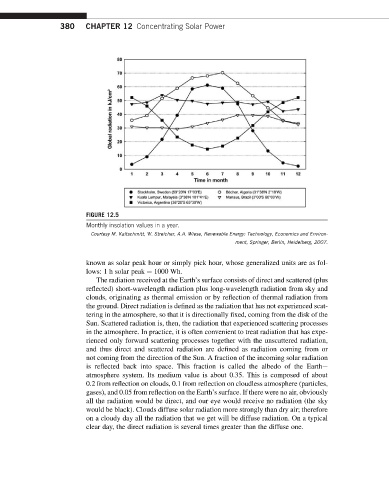
                         FIGURE 12.5
                         Monthly insolation values in a year.
                          Courtesy M. Kaltschmitt, W. Streicher, A.A. Wiese, Renewable Energy: Technology, Economics and Environ-
                                                                  ment, Springer, Berlin, Heidelberg, 2007.

                         known as solar peak hour or simply pick hour, whose generalized units are as fol-
                         lows: 1 h solar peak ¼ 1000 Wh.
                            The radiation received at the Earth’s surface consists of direct and scattered (plus
                         reflected) short-wavelength radiation plus long-wavelength radiation from sky and
                         clouds, originating as thermal emission or by reflection of thermal radiation from
                         the ground. Direct radiation is defined as the radiation that has not experienced scat-
                         tering in the atmosphere, so that it is directionally fixed, coming from the disk of the
                         Sun. Scattered radiation is, then, the radiation that experienced scattering processes
                         in the atmosphere. In practice, it is often convenient to treat radiation that has expe-
                         rienced only forward scattering processes together with the unscattered radiation,
                         and thus direct and scattered radiation are defined as radiation coming from or
                         not coming from the direction of the Sun. A fraction of the incoming solar radiation
                         is reflected back into space. This fraction is called the albedo of the Earthe
                         atmosphere system. Its medium value is about 0.35. This is composed of about
                         0.2 from reflection on clouds, 0.1 from reflection on cloudless atmosphere (particles,
                         gases), and 0.05 from reflection on the Earth’s surface. If there were no air, obviously
                         all the radiation would be direct, and our eye would receive no radiation (the sky
                         would be black). Clouds diffuse solar radiation more strongly than dry air; therefore
                         on a cloudy day all the radiation that we get will be diffuse radiation. On a typical
                         clear day, the direct radiation is several times greater than the diffuse one.

