


Page 411 - Advances in Renewable Energies and Power Technologies
P. 411
384    CHAPTER 12 Concentrating Solar Power


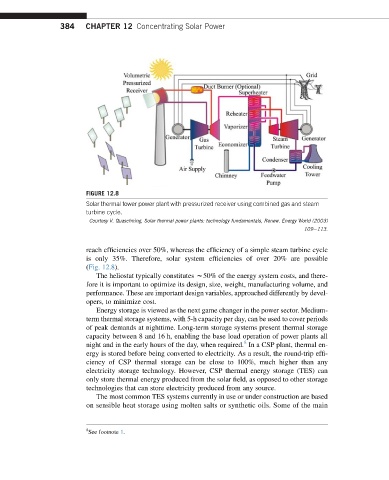
                         FIGURE 12.8
                         Solar thermal tower power plant with pressurized receiver using combined gas and steam
                         turbine cycle.
                          Courtesy V. Quaschning, Solar thermal power plants: technology fundamentals, Renew. Energy World (2003)
                                                                                     109e113.


                         reach efficiencies over 50%, whereas the efficiency of a simple steam turbine cycle
                         is only 35%. Therefore, solar system efficiencies of over 20% are possible
                         (Fig. 12.8).
                            The heliostat typically constitutes w50% of the energy system costs, and there-
                         fore it is important to optimize its design, size, weight, manufacturing volume, and
                         performance. These are important design variables, approached differently by devel-
                         opers, to minimize cost.
                            Energy storage is viewed as the next game changer in the power sector. Medium-
                         term thermal storage systems, with 5-h capacity per day, can be used to cover periods
                         of peak demands at nighttime. Long-term storage systems present thermal storage
                         capacity between 8 and 16 h, enabling the base load operation of power plants all
                                                                     8
                         night and in the early hours of the day, when required. In a CSP plant, thermal en-
                         ergy is stored before being converted to electricity. As a result, the round-trip effi-
                         ciency of CSP thermal storage can be close to 100%, much higher than any
                         electricity storage technology. However, CSP thermal energy storage (TES) can
                         only store thermal energy produced from the solar field, as opposed to other storage
                         technologies that can store electricity produced from any source.
                            The most common TES systems currently in use or under construction are based
                         on sensible heat storage using molten salts or synthetic oils. Some of the main


                         8
                          See footnote 1.

