


Page 406 - Advances in Renewable Energies and Power Technologies
P. 406
2. Solar Energy Resources: Sun Characteristics and Solar Radiation  379


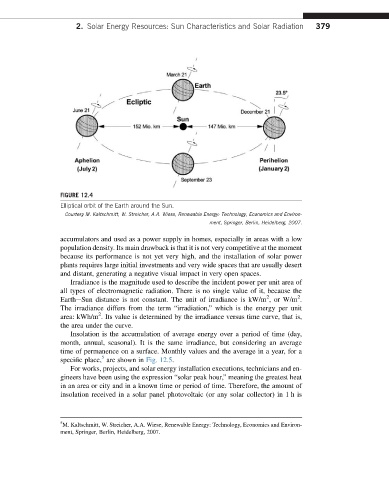
                  FIGURE 12.4
                  Elliptical orbit of the Earth around the Sun.
                   Courtesy M. Kaltschmitt, W. Streicher, A.A. Wiese, Renewable Energy: Technology, Economics and Environ-
                                                           ment, Springer, Berlin, Heidelberg, 2007.

                  accumulators and used as a power supply in homes, especially in areas with a low
                  population density. Its main drawback is that it is not very competitive at the moment
                  because its performance is not yet very high, and the installation of solar power
                  plants requires large initial investments and very wide spaces that are usually desert
                  and distant, generating a negative visual impact in very open spaces.
                     Irradiance is the magnitude used to describe the incident power per unit area of
                  all types of electromagnetic radiation. There is no single value of it, because the
                                                                                   2
                                                                           2
                  EartheSun distance is not constant. The unit of irradiance is kW/m , or W/m .
                  The irradiance differs from the term “irradiation,” which is the energy per unit
                            2
                  area: kWh/m . Its value is determined by the irradiance versus time curve, that is,
                  the area under the curve.
                     Insolation is the accumulation of average energy over a period of time (day,
                  month, annual, seasonal). It is the same irradiance, but considering an average
                  time of permanence on a surface. Monthly values and the average in a year, for a
                             5
                  specific place, are shown in Fig. 12.5.
                     For works, projects, and solar energy installation executions, technicians and en-
                  gineers have been using the expression “solar peak hour,” meaning the greatest heat
                  in an area or city and in a known time or period of time. Therefore, the amount of
                  insolation received in a solar panel photovoltaic (or any solar collector) in 1 h is


                  5
                  M. Kaltschmitt, W. Streicher, A.A. Wiese, Renewable Energy: Technology, Economics and Environ-
                  ment, Springer, Berlin, Heidelberg, 2007.

