


Page 403 - Advances in Renewable Energies and Power Technologies
P. 403
376    CHAPTER 12 Concentrating Solar Power


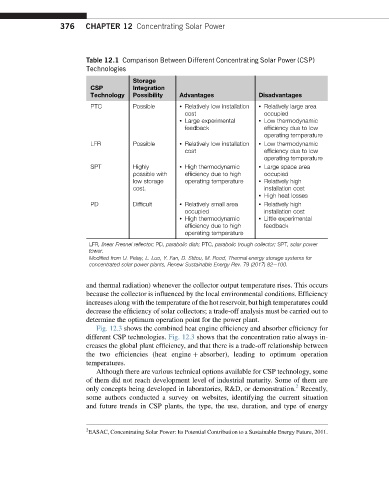
                         Table 12.1 Comparison Between Different Concentrating Solar Power (CSP)
                         Technologies
                                      Storage
                          CSP         Integration
                          Technology  Possibility  Advantages            Disadvantages
                          PTC         Possible     • Relatively low installation  • Relatively large area
                                                    cost                  occupied
                                                   • Large experimental  • Low thermodynamic
                                                    feedback              efficiency due to low
                                                                          operating temperature
                          LFR         Possible     • Relatively low installation  • Low thermodynamic
                                                    cost                  efficiency due to low
                                                                          operating temperature
                          SPT         Highly       • High thermodynamic  • Large space area
                                      possible with  efficiency due to high  occupied
                                      low storage   operating temperature  • Relatively high
                                      cost.                               installation cost
                                                                         • High heat losses
                          PD          Difficult     • Relatively small area  • Relatively high
                                                    occupied              installation cost
                                                   • High thermodynamic  • Little experimental
                                                    efficiency due to high  feedback
                                                    operating temperature
                          LFR, linear Fresnel reflector; PD, parabolic dish; PTC, parabolic trough collector; SPT, solar power
                          tower.
                          Modified from U. Pelay, L. Luo, Y. Fan, D. Stitou, M. Rood, Thermal energy storage systems for
                          concentrated solar power plants, Renew Sustainable Energy Rev. 79 (2017) 82e100.

                         and thermal radiation) whenever the collector output temperature rises. This occurs
                         because the collector is influenced by the local environmental conditions. Efficiency
                         increases along with the temperature of the hot reservoir, but high temperatures could
                         decrease the efficiency of solar collectors; a trade-off analysis must be carried out to
                         determine the optimum operation point for the power plant.
                            Fig. 12.3 shows the combined heat engine efficiency and absorber efficiency for
                         different CSP technologies. Fig. 12.3 shows that the concentration ratio always in-
                         creases the global plant efficiency, and that there is a trade-off relationship between
                         the two efficiencies (heat engine þ absorber), leading to optimum operation
                         temperatures.
                            Although there are various technical options available for CSP technology, some
                         of them did not reach development level of industrial maturity. Some of them are
                                                                                   2
                         only concepts being developed in laboratories, R&D, or demonstration. Recently,
                         some authors conducted a survey on websites, identifying the current situation
                         and future trends in CSP plants, the type, the use, duration, and type of energy


                         2
                          EASAC, Concentrating Solar Power: Its Potential Contribution to a Sustainable Energy Future, 2011.

