


Page 410 - Advances in Renewable Energies and Power Technologies
P. 410
3. Concentrating Solar Power Plants   383


                     The efficiency of a solar thermal power plant is the product of the collector field
                  and steam-cycle efficiencies. The collector efficiency depends on the sunlight inci-
                  dence angle and the temperature in the absorber tube and can reach values up to
                  75%. Field losses are usually under 10%. Altogether, solar thermal trough power
                  plants can reach annual efficiencies of w15%. The steam-cycle efficiency
                  (w35%) has the most significant influence on the overall efficiency. Central receiver
                  systems, such as solar thermal power plants, can reach higher temperatures and
                  therefore achieve higher efficiencies.
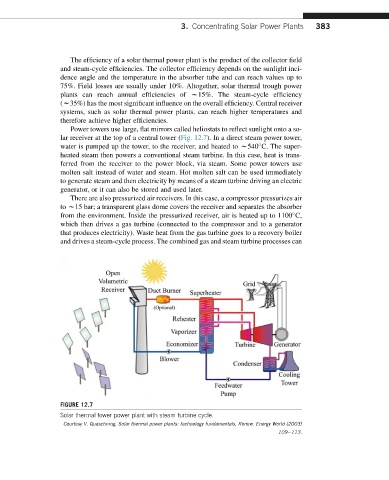
                     Power towers use large, flat mirrors called heliostats to reflect sunlight onto a so-
                  lar receiver at the top of a central tower (Fig. 12.7). In a direct steam power tower,

                  water is pumped up the tower, to the receiver, and heated to w540 C. The super-
                  heated steam then powers a conventional steam turbine. In this case, heat is trans-
                  ferred from the receiver to the power block, via steam. Some power towers use
                  molten salt instead of water and steam. Hot molten salt can be used immediately
                  to generate steam and then electricity by means of a steam turbine driving an electric
                  generator, or it can also be stored and used later.
                     There are also pressurized air receivers. In this case, a compressor pressurizes air
                  to w15 bar; a transparent glass dome covers the receiver and separates the absorber
                  from the environment. Inside the pressurized receiver, air is heated up to 1100 C,

                  which then drives a gas turbine (connected to the compressor and to a generator
                  that produces electricity). Waste heat from the gas turbine goes to a recovery boiler
                  and drives a steam-cycle process. The combined gas and steam turbine processes can


                  FIGURE 12.7
                  Solar thermal tower power plant with steam turbine cycle.
                   Courtesy V. Quaschning, Solar thermal power plants: technology fundamentals, Renew. Energy World (2003)
                                                                              109e113.

