


Page 409 - Advances in Renewable Energies and Power Technologies
P. 409
382    CHAPTER 12 Concentrating Solar Power


                            Parabolic trough consists of long curved mirrors that concentrate sunlight on a
                         liquid inside a tube that runs parallel to the mirror. The liquid heat is generally
                         used to produce steam that drives a steam turbine. Power towers use fields of mirrors
                         to concentrate sunlight on the top of central towers, in which the intense heat, gener-
                         ally carried by molten salts, boils water, and the steam then drives turbines.
                            Another type of CSP plant, although not yet broadly in use, is the PD. This sys-
                         tem focuses the sunlight on a single point. Dish concentrating technology uses a Stir-
                         ling engine to produce power. A Stirling engine produces power by way of mirrors
                         that reflect sunlight on the outside of the engine.
                            Similar to parabolic troughs, concentrating LFR systems use multiple flat mirrors
                         to concentrate solar sunlight onto the receiver tube. The same concept is applied
                         where the liquid running in the heated tube is used to boil water and drive a steam
                         turbine. Both these technologies are based on linear solar concentration.
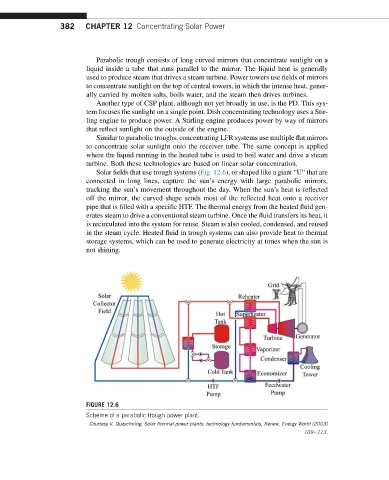
                            Solar fields that use trough systems (Fig. 12.6), or shaped like a giant “U” that are
                         connected in long lines, capture the sun’s energy with large parabolic mirrors,
                         tracking the sun’s movement throughout the day. When the sun’s heat is reflected
                         off the mirror, the curved shape sends most of the reflected heat onto a receiver
                         pipe that is filled with a specific HTF. The thermal energy from the heated fluid gen-
                         erates steam to drive a conventional steam turbine. Once the fluid transfers its heat, it
                         is recirculated into the system for reuse. Steam is also cooled, condensed, and reused
                         in the steam cycle. Heated fluid in trough systems can also provide heat to thermal
                         storage systems, which can be used to generate electricity at times when the sun is
                         not shining.


                         FIGURE 12.6
                         Scheme of a parabolic trough power plant.
                          Courtesy V. Quaschning, Solar thermal power plants: technology fundamentals, Renew. Energy World (2003)
                                                                                     109e113.

