


Page 166 - Aerodynamics for Engineering Students
P. 166
Potential flow  149

              where the integrals are to be understood as being carried out over the contour (or
              surface) of the body. Until the advent of modern computers the result (3.89) was of
              relatively little practical use. Owing to the power of modern computers, however, it
              has become the basis of  a  computational technique that  is now  commonplace in
              aerodynamic design.
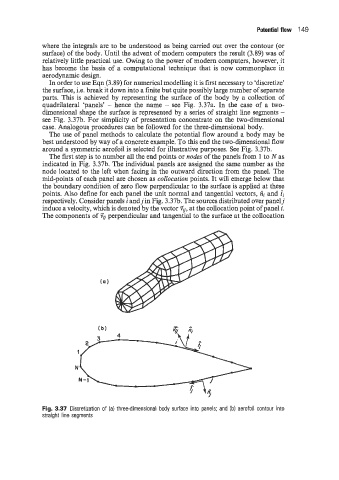
                In order to use Eqn (3.89) for numerical modelling it is first necessary to ‘discretize’
              the surface, i.e. break it down into a finite but quite possibly large number of separate
              parts. This is achieved by  representing the  surface of  the body by  a collection of
              quadrilateral  ‘panels’ - hence the  name - see  Fig.  3.37a.  In  the  case  of  a  two-
              dimensional shape the surface is represented by a series of straight line segments -
              see Fig. 3.37b.  For  simplicity of presentation concentrate on the two-dimensional
              case. Analogous procedures can be followed for the three-dimensional body.
                The use of panel methods to calculate the potential flow around a body may be
              best understood by way of a concrete example. To this end the two-dimensional flow
              around a symmetric aerofoil is selected for illustrative purposes. See Fig. 3.37b.
                The first step is to number all the end points or nodes of the panels from 1 to N as
              indicated in Fig. 3.37b. The individual panels are assigned the same number as the
              node located to the left when facing in the outward direction from the panel. The
              mid-points of each panel are chosen as coZIocation points. It will emerge below that
              the boundary condition of zero flow perpendicular to the surface is applied at these
              points. Also define for each panel the unit normal and tangential vectors, fii and ii
              respectively. Consider panels i andj in Fig. 3.37b. The sources distributed over panelj
              induce a velocity, which is denoted by the vector ?q, at the collocation point of panel i.
              The components of ?g  perpendicular and tangential to the surface at the collocation


              Fig. 3.37 Discretization of  (a) three-dimensional  body surface  into  panels;  and (b) aerofoil contour  into
              straight line segments

