


Page 148 - Air and gas Drilling Field Guide 3rd Edition
P. 148
5.8 Membrane Field Nitrogen Generator      139


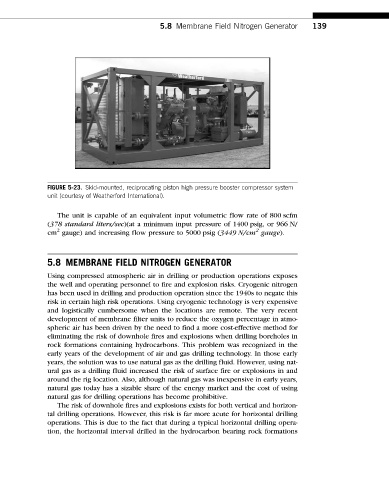
              FIGURE 5-23. Skid-mounted, reciprocating piston high pressure booster compressor system
              unit (courtesy of Weatherford International).

                 The unit is capable of an equivalent input volumetric flow rate of 800 scfm
              (378 standard liters/sec)(at a minimum input pressure of 1400 psig, or 966 N/
                 2                                                      2
              cm gauge) and increasing flow pressure to 5000 psig (3449 N/cm gauge).


              5.8 MEMBRANE FIELD NITROGEN GENERATOR
              Using compressed atmospheric air in drilling or production operations exposes
              the well and operating personnel to fire and explosion risks. Cryogenic nitrogen
              has been used in drilling and production operation since the 1940s to negate this
              risk in certain high risk operations. Using cryogenic technology is very expensive
              and logistically cumbersome when the locations are remote. The very recent
              development of membrane filter units to reduce the oxygen percentage in atmo-
              spheric air has been driven by the need to find a more cost-effective method for
              eliminating the risk of downhole fires and explosions when drilling boreholes in
              rock formations containing hydrocarbons. This problem was recognized in the
              early years of the development of air and gas drilling technology. In those early
              years, the solution was to use natural gas as the drilling fluid. However, using nat-
              ural gas as a drilling fluid increased the risk of surface fire or explosions in and
              around the rig location. Also, although natural gas was inexpensive in early years,
              natural gas today has a sizable share of the energy market and the cost of using
              natural gas for drilling operations has become prohibitive.
                 The risk of downhole fires and explosions exists for both vertical and horizon-
              tal drilling operations. However, this risk is far more acute for horizontal drilling
              operations. This is due to the fact that during a typical horizontal drilling opera-
              tion, the horizontal interval drilled in the hydrocarbon bearing rock formations

