


Page 146 - Air and gas Drilling Field Guide 3rd Edition
P. 146
5.7 Example Compressor System Units       137


                 This compressor system is probably one of the most reliable systems in the dril-
              ling industry. These compressor systems were introduced in the early 1980s to pro-
              vide compressed air for deep steam production wells in the Geysers geothermal
              fields of northern California. This application required the drilling of 11-in
              (280 mm)-diameter wells to depths in excess of 10,000 ft (3048 m). During the
              drilling of these wells, steam inflows to the wells were nearly always encountered,
              which increased the injection pressure requirements greatly. No similar air drilling
              requirements have been encountered in the drilling of deep oil and natural gas
              wells. Not only do these compressor systems produce a very useful volumetric flow
              rate, but they can produce this volumetric flow rate at a great variety of pressures
                                                     2
              (i.e., from 100 to 1200 psig, or 69 to 828 N/cm gauge). Because these units are reci-
              procating piston compressors, the volumetric flow rate is not affected by the pres-
              sure output. This compressor system is presently the highest quality unit on the
              market and should be considered for any critical or risky air drilling operation.
                 The compressor is directly coupled to a Caterpillar Model D398 prime mover.
              The Caterpillar Model D398 is a V-12 piston configuration. The prime mover is
              diesel fueled, turbocharged, and aftercooled. At the rotation speed of 900 rpm,
              the prime mover can produce a peak of 760 hp (567 kW).


              5.7.3 Rotary Primary and Reciprocating Piston
              Booster Compressor System
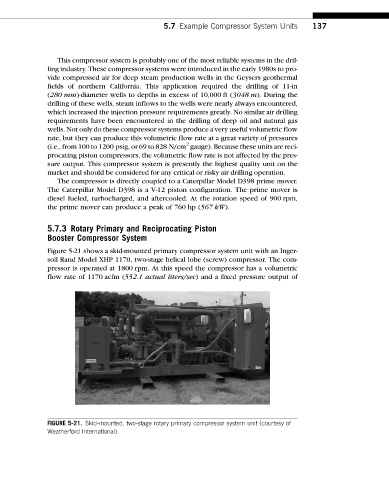
              Figure 5-21 shows a skid-mounted primary compressor system unit with an Inger-
              soll Rand Model XHP 1170, two-stage helical lobe (screw) compressor. The com-
              pressor is operated at 1800 rpm. At this speed the compressor has a volumetric
              flow rate of 1170 acfm (552.1 actual liters/sec) and a fixed pressure output of


              FIGURE 5-21. Skid-mounted, two-stage rotary primary compressor system unit (courtesy of
              Weatherford International).

