


Page 149 - Air and gas Drilling Field Guide 3rd Edition
P. 149
140     CHAPTER 5 Compressors and Nitrogen Generators


                          is several times longer than in a typical vertical interval drilled in a vertical drilling
                          operation (assuming similar hydrocarbon bearing rock formations). Further, the
                          drilling rate of penetration for a horizontal drilling operation will be about half
                          that of vertical drilling (assuming the similar rock type). This further increases
                          the drilling time in the hydrocarbon bearing formation.


                          5.8.1 Allowable Oxygen Concentrations
                          For the past two decades, membrane technologies have been used to separate
                          oxygen (and some other molecules) from gas mixtures, particularly atmospheric
                          air. Because of the high cost of horizontal wells, membrane technology has been
                          developed that can provide high volumetric flow rates of inert atmospheric air
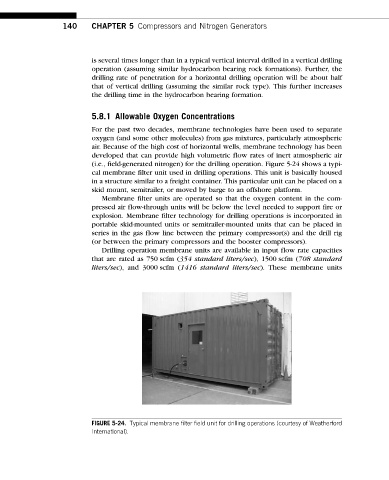
                          (i.e., field-generated nitrogen) for the drilling operation. Figure 5-24 shows a typi-
                          cal membrane filter unit used in drilling operations. This unit is basically housed
                          in a structure similar to a freight container. This particular unit can be placed on a
                          skid mount, semitrailer, or moved by barge to an offshore platform.
                             Membrane filter units are operated so that the oxygen content in the com-
                          pressed air flow-through units will be below the level needed to support fire or
                          explosion. Membrane filter technology for drilling operations is incorporated in
                          portable skid-mounted units or semitrailer-mounted units that can be placed in
                          series in the gas flow line between the primary compressor(s) and the drill rig
                          (or between the primary compressors and the booster compressors).
                             Drilling operation membrane units are available in input flow rate capacities
                          that are rated as 750 scfm (354 standard liters/sec), 1500 scfm (708 standard
                          liters/sec), and 3000 scfm (1416 standard liters/sec). These membrane units


                          FIGURE 5-24. Typical membrane filter field unit for drilling operations (courtesy of Weatherford
                          International).

