


Page 178 - Air and gas Drilling Field Guide 3rd Edition
P. 178
7.2 General Derivation    169


                                                      2
              where p pl is the pipeline pressure (psia, N/cm abs), P pl is the pipeline pressure
                            2
                  2


              (lb/ft abs, N/m abs), t pl is the pipeline temperature ( F, C), and T pl is the abso-

              lute pipeline temperature ( R, K).
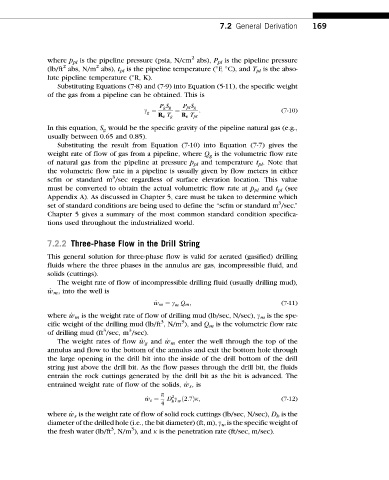
                 Substituting Equations (7-8) and (7-9) into Equation (5-11), the specific weight
              of the gas from a pipeline can be obtained. This is
                                             P g S g  P pl S g
                                         g ¼     ¼      :                      (7-10)
                                          g
                                             R e T g  R e T pl
              In this equation, S g would be the specific gravity of the pipeline natural gas (e.g.,
              usually between 0.65 and 0.85).
                 Substituting the result from Equation (7-10) into Equation (7-7) gives the
              weight rate of flow of gas from a pipeline, where Q g is the volumetric flow rate
              of natural gas from the pipeline at pressure p pl and temperature t pl . Note that
              the volumetric flow rate in a pipeline is usually given by flow meters in either
                                3
              scfm or standard m /sec regardless of surface elevation location. This value
              must be converted to obtain the actual volumetric flow rate at p pl and t pl (see
              Appendix A). As discussed in Chapter 5, care must be taken to determine which
                                                                              3
              set of standard conditions are being used to define the “scfm or standard m /sec.”
              Chapter 5 gives a summary of the most common standard condition specifica-
              tions used throughout the industrialized world.


              7.2.2 Three-Phase Flow in the Drill String
              This general solution for three-phase flow is valid for aerated (gasified) drilling
              fluids where the three phases in the annulus are gas, incompressible fluid, and
              solids (cuttings).
                 The weight rate of flow of incompressible drilling fluid (usually drilling mud),
               _ w m , into the well is
                                            _ w m ¼ g Q m ;                    (7-11)
                                                 m
              where _ w m is the weight rate of flow of drilling mud (lb/sec, N/sec), g m is the spe-
                                                   3
                                              3
              cific weight of the drilling mud (lb/ft , N/m ), and Q m is the volumetric flow rate
                              3
                                     3
              of drilling mud (ft /sec, m /sec).
                 The weight rates of flow _ w g and _ w m enter the well through the top of the
              annulus and flow to the bottom of the annulus and exit the bottom hole through
              the large opening in the drill bit into the inside of the drill bottom of the drill
              string just above the drill bit. As the flow passes through the drill bit, the fluids
              entrain the rock cuttings generated by the drill bit as the bit is advanced. The
              entrained weight rate of flow of the solids, _ w s ,is

                                              p  2
                                          _ w s ¼  D g 2:7ð  Þk;               (7-12)
                                                 h w
                                              4
              where _ w s is the weight rate of flow of solid rock cuttings (lb/sec, N/sec), D h is the
              diameter of the drilled hole (i.e., the bit diameter) (ft, m), g w is the specific weight of
                                3
                                     3
              the fresh water (lb/ft , N/m ), and k is the penetration rate (ft/sec, m/sec).

