


Page 183 - Air and gas Drilling Field Guide 3rd Edition
P. 183
174     CHAPTER 7 Reverse Circulation Models


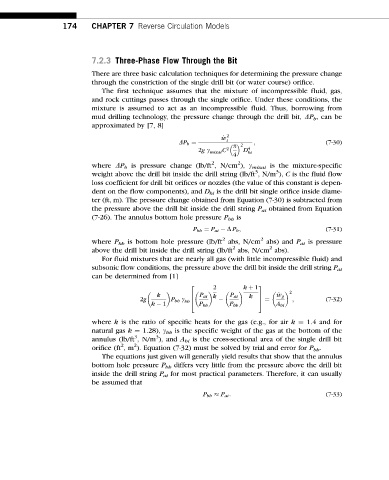
                          7.2.3 Three-Phase Flow Through the Bit
                          There are three basic calculation techniques for determining the pressure change
                          through the constriction of the single drill bit (or water course) orifice.
                             The first technique assumes that the mixture of incompressible fluid, gas,
                          and rock cuttings passes through the single orifice. Under these conditions, the
                          mixture is assumed to act as an incompressible fluid. Thus, borrowing from
                          mud drilling technology, the pressure change through the drill bit, DP b , can be
                          approximated by [7, 8]

                                                               _ w 2 t
                                                   DP b ¼              ;                   (7-30)
                                                                  p 2

                                                               C  2  D 4
                                                        2g g mixai    bi
                                                                  4
                                                            2      2
                          where DP b is pressure change (lb/ft , N/cm ), g mixai is the mixture-specific
                                                                        3    3
                          weight above the drill bit inside the drill string (lb/ft , N/m ), C is the fluid flow
                          loss coefficient for drill bit orifices or nozzles (the value of this constant is depen-
                          dent on the flow components), and D bi is the drill bit single orifice inside diame-
                          ter (ft, m). The pressure change obtained from Equation (7-30) is subtracted from
                          the pressure above the drill bit inside the drill string P ai obtained from Equation
                          (7-26). The annulus bottom hole pressure P bh is
                                                       P bh ¼ P ai   D P b ;               (7-31)
                                                                         2
                                                               2
                          where P bh is bottom hole pressure (lb/ft abs, N/cm abs) and P ai is pressure
                                                                            2
                                                                 2
                          above the drill bit inside the drill string (lb/ft abs, N/cm abs).
                             For fluid mixtures that are nearly all gas (with little incompressible fluid) and
                          subsonic flow conditions, the pressure above the drill bit inside the drill string P ai
                          can be determined from [1]
                                                            2       k þ 1
                                                      2                  3
                                                                                  2
                                             k          P ai k   P ai         _ w g
                                        2g          bh 6              k 7         ;        (7-32)
                                                                         5 ¼
                                           k   1  P bh g 4  P bh  P bh        A bi
                          where k is the ratio of specific heats for the gas (e.g., for air k ¼ 1.4 and for
                          natural gas k ¼ 1.28), g bh is the specific weight of the gas at the bottom of the
                                      3
                                            3
                          annulus (lb/ft , N/m ), and A bi is the cross-sectional area of the single drill bit
                                  2
                                      2
                          orifice (ft ,m ). Equation (7-32) must be solved by trial and error for P bh .
                             The equations just given will generally yield results that show that the annulus
                          bottom hole pressure P bh differs very little from the pressure above the drill bit
                          inside the drill string P ai for most practical parameters. Therefore, it can usually
                          be assumed that
                                                         P bh   P ai :                     (7-33)

