


Page 188 - Air and gas Drilling Field Guide 3rd Edition
P. 188
7.5 Air and Gas Drilling Model    179


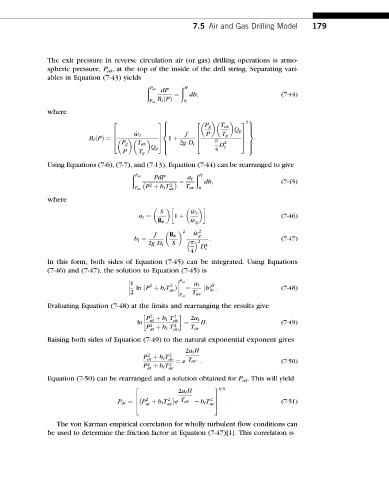
              The exit pressure in reverse circulation air (or gas) drilling operations is atmo-
              spheric pressure, P at , at the top of the inside of the drill string. Separating vari-
              ables in Equation (7-43) yields
                                          ð        ð  H
                                           P ai
                                              dP
                                                 ¼   dh;                       (7-44)
                                             B i PðÞ  0
                                          P at
              where
                                              8                       9
                                                                    32
                                2            3         2
                                                          P g
                                              >               T av    >
                                              >                       >
                                              >                   Q g  >
                                              <     f     P           =
                                6      _ w t  7        6       T g  7
                                6            7  1 þ    6            7  :
                          B i PðÞ ¼
                                   P g  T av  >    2gD i      D       >
                                4            5         4     p  2   5
                                              >                       >
                                              >              4  i     >
                                   P    T g  Q g :                    ;
              Using Equations (7-6), (7-7), and (7-13), Equation (7-44) can be rearranged to give
                                      ð                ð H
                                      P ai  PdP      a i
                                                   ¼      dh;                  (7-45)

                                          2
                                         P þ b i T  2  T av
                                      P at      av      0
              where

                                             S        _ w s
                                       a i ¼     1 þ                           (7-46)
                                                      _ w g
                                             R e
                                                    2   2
                                            f          _ w g
                                      b i ¼     R e        :                   (7-47)
                                                      p 2
                                                 S
                                          2gD i           4
                                                         D
                                                      4   i
              In this form, both sides of Equation (7-45) can be integrated. Using Equations
              (7-46) and (7-47), the solution to Equation (7-45) is
                                                    P
                                                    ai
                                     1     2           a i  H
                                        ln ðP þ b i T Þ  ¼  jhj :              (7-48)
                                                2
                                     2                T av
                                                av          0
                                                   P at
              Evaluating Equation (7-48) at the limits and rearranging the results give
                                            2    2
                                          P þ b i T   2a i
                                       ln  ai    av  ¼   H:                    (7-49)
                                           2
                                         P þ b i T  2  T av
                                           at    av
              Raising both sides of Equation (7-49) to the natural exponential exponent gives
                                                    2a i H
                                                2
                                          2
                                         P þ b i T av  ¼ e  T av :             (7-50)
                                          ai
                                          2
                                         P þ b i T 2
                                          at    av
              Equation (7-50) can be rearranged and a solution obtained for P ai . This will yield
                                      2                      3 0:5
                                                  2a i H

                                        P þ b i T  e                           (7-51)
                                                           2 7
                                      6  2     2   T av   b i T 5 :
                                  P ai ¼ 4  at  av         av
                 The von Karman empirical correlation for wholly turbulent flow conditions can
              be used to determine the friction factor in Equation (7-47)[1]. This correlation is

