


Page 191 - Air and gas Drilling Field Guide 3rd Edition
P. 191
182     CHAPTER 7 Reverse Circulation Models


                          where e av is the approximate average absolute roughness of the annulus surfaces
                          (ft, m). Note that the logarithm in the equation is to the base 10.
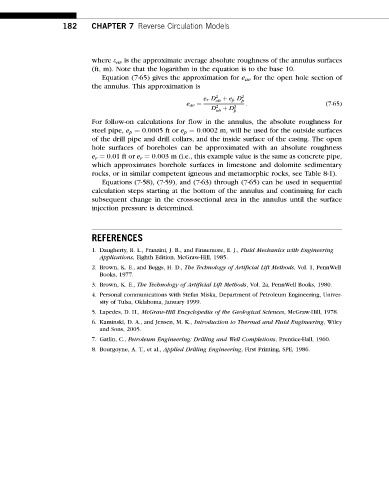
                             Equation (7-65) gives the approximation for e av for the open hole section of
                          the annulus. This approximation is

                                                         e r D 2 oh  þ e p D 2 p
                                                     e av ¼          :                     (7-65)
                                                            D 2  þ D 2
                                                             oh   p
                          For follow-on calculations for flow in the annulus, the absolute roughness for
                          steel pipe, e p ¼ 0.0005 ft or e p ¼ 0.0002 m, will be used for the outside surfaces
                          of the drill pipe and drill collars, and the inside surface of the casing. The open
                          hole surfaces of boreholes can be approximated with an absolute roughness
                          e r ¼ 0.01 ft or e r ¼ 0.003 m (i.e., this example value is the same as concrete pipe,
                          which approximates borehole surfaces in limestone and dolomite sedimentary
                          rocks, or in similar competent igneous and metamorphic rocks, see Table 8-1).
                             Equations (7-58), (7-59), and (7-63) through (7-65) can be used in sequential
                          calculation steps starting at the bottom of the annulus and continuing for each
                          subsequent change in the cross-sectional area in the annulus until the surface
                          injection pressure is determined.


                          REFERENCES
                          1. Daugherty, R. L., Franzini, J. B., and Finnemore, E. J., Fluid Mechanics with Engineering
                             Applications, Eighth Edition, McGraw-Hill, 1985.
                          2. Brown, K. E., and Beggs, H. D., The Technology of Artificial Lift Methods, Vol. 1, PennWell
                             Books, 1977.
                          3. Brown, K. E., The Technology of Artificial Lift Methods, Vol. 2a, PennWell Books, 1980.
                          4. Personal communications with Stefan Miska, Department of Petroleum Engineering, Univer-
                             sity of Tulsa, Oklahoma, January 1999.
                          5. Lapedes, D. H., McGraw-Hill Encyclopedia of the Geological Sciences, McGraw-Hill, 1978.
                          6. Kaminski, D. A., and Jensen, M. K., Introduction to Thermal and Fluid Engineering, Wiley
                             and Sons, 2005.
                          7. Gatlin, C., Petroleum Engineering: Drilling and Well Completions, Prentice-Hall, 1960.
                          8. Bourgoyne, A. T., et al., Applied Drilling Engineering, First Printing, SPE, 1986.

