


Page 187 - Air and gas Drilling Field Guide 3rd Edition
P. 187
178     CHAPTER 7 Reverse Circulation Models


                          7.4 STABLE FOAM DRILLING MODEL
                          As stated earlier, reverse circulation operations are useful in drilling large diame-
                          ter shallow surface casing boreholes. Stable foam drilling operations are not use-
                          ful for this type of drilling operation. Stable foam drilling is used in reverse
                          circulation operations in shallow moderate diameter wells only (e.g., depths less
                          that approximately 3000 ft or 900 m), such as deep water wells and other nonpe-
                          troleum industry-related wells. The reason for this limitation is because the
                          reverse circulation drill bit with its large open orifice does not create the high
                          shear rate on the drilling fluid needed to generate the stable foam as the foam
                          enters the bottom of the drill string with the rock cuttings. Therefore, the stable
                          foam must be generated at the surface and injected into the top of the annulus;
                          this foam must not break down as it circulates through the entire system. This
                          is not possible in deep large diameter boreholes.
                             However, it should be noted that stable foam reverse circulation operations
                          are used in petroleum industry deep well work over and related production
                          operations. These operations are feasible because these operations are carried
                          out in moderate diameter wells (e.g., in production casing and production tubing
                          strings).


                          7.5 AIR AND GAS DRILLING MODEL
                          Unlike the aerated and stable foam drilling fluid models, the air and gas drilling
                          model requires no special empirical correlations to adjust the results to provide
                          additional results that agree more closely to field data. Chapter 8 will give illustra-
                          tive examples for this model.
                             Air (or gas) drilling is a special case of the theory derived in Section 7.2. The
                          governing equations for air (or gas) drilling operations can be obtained by setting
                          Q m ¼ 0 in the equations derived in Section 7.2. The aforementioned assumption
                          restricts the flow in the annulus to two-phase flow (gas and rock cuttings).
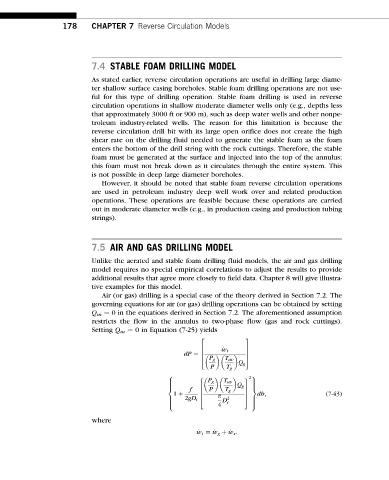
                          Setting Q m ¼ 0 in Equation (7-25) yields
                                                        2            3
                                                        6      _ w t  7
                                                        6            7
                                                    dP ¼
                                                           P g  T av
                                                        4            5
                                                                   Q g
                                                           P    T g
                                               8                       9
                                                                     32
                                                        2
                                                           P g
                                               >               T av    >
                                               >                       >
                                               >                   Q g  >
                                                      f  6  P  T g   7
                                               <                       =
                                                 1 þ    6            7  dh;                (7-43)
                                                    2gD i  4  p  2   5
                                               >               D       >
                                               >                i      >
                                                             4
                                               >                       >
                                               :                       ;
                          where
                                                        _ w t ¼ _ w g þ _ w s :

