


Page 230 - Air and gas Drilling Field Guide 3rd Edition
P. 230
9.3 Minimum Volumetric Flow Rates      221


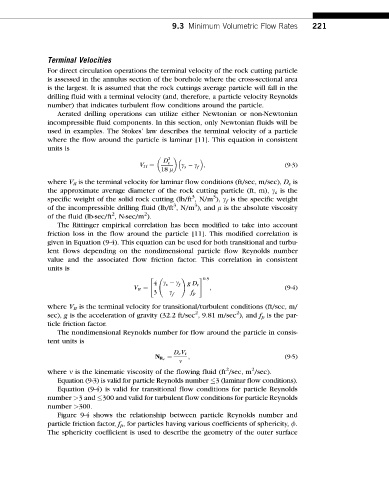
              Terminal Velocities
              For direct circulation operations the terminal velocity of the rock cutting particle
              is assessed in the annulus section of the borehole where the cross-sectional area
              is the largest. It is assumed that the rock cuttings average particle will fall in the
              drilling fluid with a terminal velocity (and, therefore, a particle velocity Reynolds
              number) that indicates turbulent flow conditions around the particle.
                 Aerated drilling operations can utilize either Newtonian or non-Newtonian
              incompressible fluid components. In this section, only Newtonian fluids will be
              used in examples. The Stokes’ law describes the terminal velocity of a particle
              where the flow around the particle is laminar [11]. This equation in consistent
              units is
                                                2
                                              D c
                                        V tl ¼     g   g ;                      (9-3)
                                                        f
                                                    s
                                              18 m
              where V tl is the terminal velocity for laminar flow conditions (ft/sec, m/sec), D c is
              the approximate average diameter of the rock cutting particle (ft, m), g s is the
                                                      3
                                                            3
              specific weight of the solid rock cutting (lb/ft , N/m ), g f is the specific weight
                                                       3
                                                 3
              of the incompressible drilling fluid (lb/ft , N/m ), and m is the absolute viscosity
                                2
                                         2
              of the fluid (lb-sec/ft , N-sec/m ).
                 The Rittinger empirical correlation has been modified to take into account
              friction loss in the flow around the particle [11]. This modified correlation is
              given in Equation (9-4). This equation can be used for both transitional and turbu-
              lent flows depending on the nondimensional particle flow Reynolds number
              value and the associated flow friction factor. This correlation in consistent
              units is
                                           "       !    # 0:5
                                               s
                                            4 g   g f  gD c
                                      V tt ¼               ;                    (9-4)
                                            3   g f   f p
              where V tt is the terminal velocity for transitional/turbulent conditions (ft/sec, m/
                                                       2
                                                                   2
              sec), g is the acceleration of gravity (32.2 ft/sec , 9.81 m/sec ), and f p is the par-
              ticle friction factor.
                 The nondimensional Reynolds number for flow around the particle in consis-
              tent units is
                                                 D c V t
                                               ¼     ;                          (9-5)
                                            N R c
                                                   n
                                                                2
                                                                       2
              where n is the kinematic viscosity of the flowing fluid (ft /sec, m /sec).
                 Equation (9-3) is valid for particle Reynolds number  3 (laminar flow conditions).
                 Equation (9-4) is valid for transitional flow conditions for particle Reynolds
              number >3 and  300 and valid for turbulent flow conditions for particle Reynolds
              number >300.
                 Figure 9-4 shows the relationship between particle Reynolds number and
              particle friction factor, f p , for particles having various coefficients of sphericity, f.
              The sphericity coefficient is used to describe the geometry of the outer surface

