


Page 250 - Air and gas Drilling Field Guide 3rd Edition
P. 250
9.4 Nonfriction and Friction Illustrative Examples  241


                                           Pressure (psia)
                             0      1000     2000    3000     4000
                            0                                       0
                                     Injection
                                                                    –500
                        –2000
                               Exit
                                                                    –1000
                        –4000
                       Depth (ft)                   Inside Drill String  –1500  Depth (m)


                        –6000
                                  Annulus
                                                                    –2000
                        –8000                               Bit     –2500


                        –10000                                      –3000
                             0    500   1000  1500  2000  2500   3000
                                                    2
                                         Pressure (N/cm  abs)

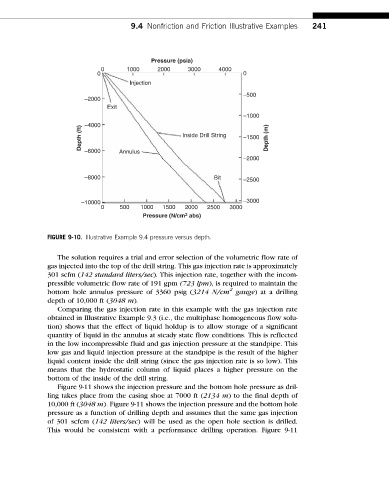
              FIGURE 9-10. Illustrative Example 9.4 pressure versus depth.

                 The solution requires a trial and error selection of the volumetric flow rate of
              gas injected into the top of the drill string. This gas injection rate is approximately
              301 scfm (142 standard liters/sec). This injection rate, together with the incom-
              pressible volumetric flow rate of 191 gpm (723 lpm), is required to maintain the
                                                                 2
              bottom hole annulus pressure of 3360 psig (3214 N/cm gauge) at a drilling
              depth of 10,000 ft (3048 m).
                 Comparing the gas injection rate in this example with the gas injection rate
              obtained in Illustrative Example 9.3 (i.e., the multiphase homogeneous flow solu-
              tion) shows that the effect of liquid holdup is to allow storage of a significant
              quantity of liquid in the annulus at steady state flow conditions. This is reflected
              in the low incompressible fluid and gas injection pressure at the standpipe. This
              low gas and liquid injection pressure at the standpipe is the result of the higher
              liquid content inside the drill string (since the gas injection rate is so low). This
              means that the hydrostatic column of liquid places a higher pressure on the
              bottom of the inside of the drill string.
                 Figure 9-11 shows the injection pressure and the bottom hole pressure as dril-
              ling takes place from the casing shoe at 7000 ft (2134 m) to the final depth of
              10,000 ft (3048 m). Figure 9-11 shows the injection pressure and the bottom hole
              pressure as a function of drilling depth and assumes that the same gas injection
              of 301 scfcm (142 liters/sec) will be used as the open hole section is drilled.
              This would be consistent with a performance drilling operation. Figure 9-11

