


Page 256 - Air and gas Drilling Field Guide 3rd Edition
P. 256
10.1 Stable Foam Rheology      247


              10.1 STABLE FOAM RHEOLOGY
              Stable foam work over and drilling fluids have been used by the oil and gas indus-
              try since the 1950s [1–4]. Since the introduction of foam drilling fluids there have
              been efforts to mathematically describe the rheology of stable foam fluids. In the
              1970s, the first serious experimental and practical mathematical modeling studies
              were carried out to describe the static and dynamic physical characteristics of sta-
              ble foam [5–8]. In the 1980s, successful foam rheology and flow models were
              developed. One practical power law mathematical model was developed by
              Sanghani for foam flowing in pipe and in annulus geometry pressure conduits
              [9]. In addition, the most extensive foam experiments were conducted by Ikoku,
              Okpobiri, and Machado, which described the frictional resistance of the foam
              structure flow in pipes and the motion of solids cutting in these structures [10–
              13]. During the 1990s, field operational data became available that could be com-
              pared with the existing rheologic and flow models [14, 15]. In the early 2000s,
              Guo, Sun, and Ghalambor correlated the Sanghani power law model with the
              extensive experimental data of Ikoku and colleagues [16].
                 Laboratory and field experiments show that stable foam will exist within
              certain limits of the foam quality value. These limits are approximately the foam
              qualities of 0.60 and 0.98 [9–11, 13]. If the foam quality value falls below approx-
              imately 0.60, the foam will separate into its two phases. If the foam quality value
              is above 0.98, the stable continuous foam becomes unstable in that the foam
              flows as slugs of foam (which is denoted as “mist” as described in Chapter 8).
              For stable foam deep drilling operations the lower foam quality values are usually
              at the bottom of the annulus and the higher foam quality values at the top of the
              annulus.
                 Stable foam is a complex flowing structure, which has viscosities that change
              as a function of pressure, temperature, and pressure conduit geometry. Under-
              standing the viscosity change mechanism of the foam drilling fluid is critical to
              the successful development of practical predictive flow models. In general, the
              parameters of pressure, temperature, and geometry can be represented more
              conveniently by foam quality, foam average velocity, and the effective diameter
              of the pipe or annulus. Experiments have shown that viscosity magnitude can
              increase 10 to 15 times as the foam quality is increased from 0.60 to 0.98. A simi-
              lar change can accompany changes in velocity and effective diameter [17].
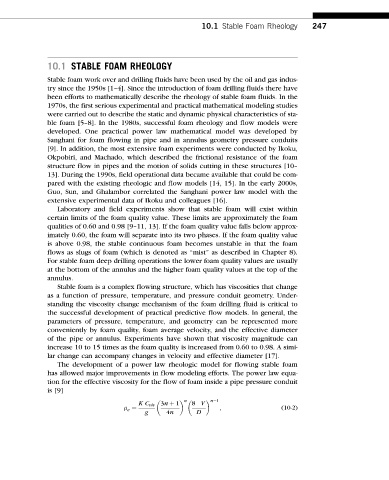
                 The development of a power law rheologic model for flowing stable foam
              has allowed major improvements in flow modeling efforts. The power law equa-
              tion for the effective viscosity for the flow of foam inside a pipe pressure conduit
              is [9]
                                                    n

                                       KC vis 3n þ 1     8 V    n 1
                                   m ¼                        ;                (10-2)
                                    e
                                         g     4n      D

