


Page 258 - Air and gas Drilling Field Guide 3rd Edition
P. 258
10.1 Stable Foam Rheology      249


              of a proposed mixture of water, surfactant, and additives in a future drilling project,
              it is necessary to (1) establish a nominal baseline laboratory assessment of a stable
              foam mixture that has undergone extensive laboratory experimental assessments
              and has a record of good performance in the field; (2) devise and use a simple lab-
              oratory test that could be used to measure other potential stable foam mixtures
              against the nominal baseline mixture; and (3) create an empirical relationship that
              can be used to predict the future performance and, more importantly, the future
              nonperformance of nonbaseline drilling project mixtures. In this stable foam per-
              formance screening, the quality of the water used in a drilling project cannot be
              overemphasized. Therefore, it is very important that the actual water used in a
              forthcoming drilling operation be used in these laboratory screening tests.
                 A screening test used by a few of the companies is a highly modified version
              of an ASTM foam properties test [17]. The test requires the use of a commercial
              blender and a tall 1000-ml beaker. The actual mixture of drilling project water,
              surfactants, and additives is to be used in the test. One hundred milliliters of
              the drilling project water with its additives (excluding the surfactant) is placed
              in the blender. The appropriate quantity of surfactant is placed in the blender
              with the water plus additives mixture. The blender is operated with an open
              top for 10 min. Stable foam will be created as the blender is operated. At the
              end ofthe blending time,aspatulaisusedtopour all thestablefoaminthe
              blender into the beaker. The total “height” in milliliters of the mixture is
              recorded (e.g., 500 ml). A stop watch is used to obtain the time needed for
              50 ml of liquidtoaccumulate at thebottomofthebeaker.Thistimeisknown
              as the “half-lifetime” of the foam mixture and is recorded in seconds (e.g.,
              200 sec). For illustration, these values will be considered “nominal baseline”
              for a stable foam mixture that has shown good performance characteristics in
              extensive laboratory dynamic flow tests and in field drilling project results.
              Using Equation (10-1), the foam quality of the nominal baseline stable foam mix-
              ture would be G ¼ 0.80.


              10.1.2 Empirical Algorithm for Screening
              Most screening empirical algorithms are constructed on the basis of the height
              and half-life ratios of the proposed drilling project mixture values to the nominal
              baseline mixture values. The expression given here is an example of such an
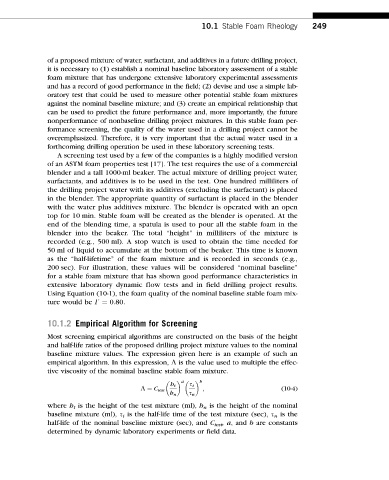
              empirical algorithm. In this expression, L is the value used to multiple the effec-
              tive viscosity of the nominal baseline stable foam mixture.
                                                   a
                                                        b
                                                h t   t t
                                        L ¼ C test       ;                     (10-4)
                                                h n  t n
              where h t is the height of the test mixture (ml), h n is the height of the nominal
              baseline mixture (ml), t t is the half-life time of the test mixture (sec), t n is the
              half-life of the nominal baseline mixture (sec), and C test ,a, and b are constants
              determined by dynamic laboratory experiments or field data.

