


Page 263 - Air and gas Drilling Field Guide 3rd Edition
P. 263
254     CHAPTER 10 Stable Foam Drilling


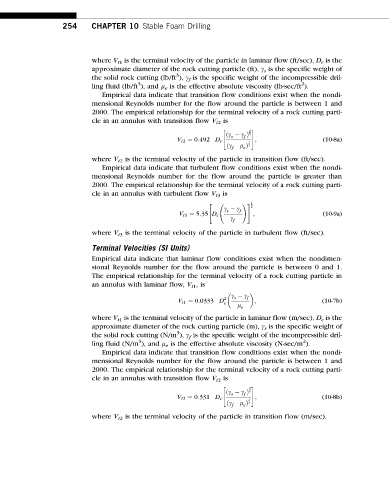
                          where V t1 is the terminal velocity of the particle in laminar flow (ft/sec), D c is the
                          approximate diameter of the rock cutting particle (ft), g s is the specific weight of
                                                  3
                          the solid rock cutting (lb/ft ), g f is the specific weight of the incompressible dril-
                                                                                     2
                                       3
                          ling fluid (lb/ft ), and m e is the effective absolute viscosity (lb-sec/ft ).
                             Empirical data indicate that transition flow conditions exist when the nondi-
                          mensional Reynolds number for the flow around the particle is between 1 and
                          2000. The empirical relationship for the terminal velocity of a rock cutting parti-
                          cle in an annulus with transition flow V t2 is
                                                               "      2 #
                                                                ðg   g Þ 3
                                                                     f
                                                                 s
                                                  V t2 ¼ 0:492 D c    1 ;                 (10-8a)
                                                                    e
                                                                ðg f  m Þ 3
                          where V t2 is the terminal velocity of the particle in transition flow (ft/sec).
                             Empirical data indicate that turbulent flow conditions exist when the nondi-
                          mensional Reynolds number for the flow around the particle is greater than
                          2000. The empirical relationship for the terminal velocity of a rock cutting parti-
                          cle in an annulus with turbulent flow V t3 is
                                                                    !#1
                                                           "
                                                                       2
                                                                s
                                                               g   g f
                                                   V t3 ¼ 5:35 D c     ;                  (10-9a)
                                                                 g f
                          where V t3 is the terminal velocity of the particle in turbulent flow (ft/sec).
                          Terminal Velocities (SI Units)
                          Empirical data indicate that laminar flow conditions exist when the nondimen-
                          sional Reynolds number for the flow around the particle is between 0 and 1.
                          The empirical relationship for the terminal velocity of a rock cutting particle in
                          an annulus with laminar flow, V t1 ,is

                                                                  s
                                                  V t1 ¼ 0:0333 D 2  g   g f  ;           (10-7b)
                                                               c
                                                                   m e
                          where V t1 is the terminal velocity of the particle in laminar flow (m/sec), D c is the
                          approximate diameter of the rock cutting particle (m), g s is the specific weight of
                                                  3
                          the solid rock cutting (N/m ), g f is the specific weight of the incompressible dril-
                                       3
                                                                                     2
                          ling fluid (N/m ), and m e is the effective absolute viscosity (N-sec/m ).
                             Empirical data indicate that transition flow conditions exist when the nondi-
                          mensional Reynolds number for the flow around the particle is between 1 and
                          2000. The empirical relationship for the terminal velocity of a rock cutting parti-
                          cle in an annulus with transition flow V t2 is
                                                                      2 #
                                                               "
                                                                      3
                                                                ðg   g Þ
                                                                 s
                                                                     f
                                                  V t2 ¼ 0:331 D c    1 ;                 (10-8b)
                                                                    e
                                                                ðg f  m Þ 3
                          where V t2 is the terminal velocity of the particle in transition flow (m/sec).

