


Page 264 - Air and gas Drilling Field Guide 3rd Edition
P. 264
10.5 Nonfriction and Friction Illustrative Examples  255


                 Empirical data indicate that turbulent flow conditions exist when the nondi-
              mensional Reynolds number for the flow around the particle is greater than
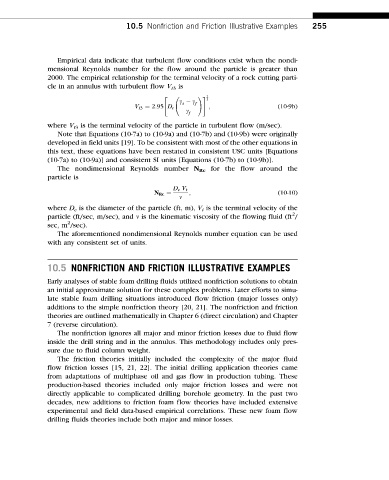
              2000. The empirical relationship for the terminal velocity of a rock cutting parti-
              cle in an annulus with turbulent flow V t3 is
                                                        !#1
                                              "
                                                          2
                                                    s
                                                   g   g f
                                      V t3 ¼ 2:95 D c      ;                  (10-9b)
                                                     g f
              where V t3 is the terminal velocity of the particle in turbulent flow (m/sec).
                 Note that Equations (10-7a) to (10-9a) and (10-7b) and (10-9b) were originally
              developed in field units [19]. To be consistent with most of the other equations in
              this text, these equations have been restated in consistent USC units [Equations
              (10-7a) to (10-9a)] and consistent SI units [Equations (10-7b) to (10-9b)].
                 The nondimensional Reynolds number N Rc for the flow around the
              particle is

                                                 D c V t
                                            N Rc ¼   ;                        (10-10)
                                                   n
              where D c is the diameter of the particle (ft, m), V t is the terminal velocity of the
                                                                                  2
              particle (ft/sec, m/sec), and n is the kinematic viscosity of the flowing fluid (ft /
                    2
              sec, m /sec).
                 The aforementioned nondimensional Reynolds number equation can be used
              with any consistent set of units.


              10.5 NONFRICTION AND FRICTION ILLUSTRATIVE EXAMPLES
              Early analyses of stable foam drilling fluids utilized nonfriction solutions to obtain
              an initial approximate solution for these complex problems. Later efforts to simu-
              late stable foam drilling situations introduced flow friction (major losses only)
              additions to the simple nonfriction theory [20, 21]. The nonfriction and friction
              theories are outlined mathematically in Chapter 6 (direct circulation) and Chapter
              7 (reverse circulation).
                 The nonfriction ignores all major and minor friction losses due to fluid flow
              inside the drill string and in the annulus. This methodology includes only pres-
              sure due to fluid column weight.
                 The friction theories initially included the complexity of the major fluid
              flow friction losses [15, 21, 22]. The initial drilling application theories came
              from adaptations of multiphase oil and gas flow in production tubing. These
              production-based theories included only major friction losses and were not
              directly applicable to complicated drilling borehole geometry. In the past two
              decades, new additions to friction foam flow theories have included extensive
              experimental and field data-based empirical correlations. These new foam flow
              drilling fluids theories include both major and minor losses.

