


Page 262 - Air and gas Drilling Field Guide 3rd Edition
P. 262
10.4 Minimum Volumetric Flow Rates       253


              increasing foam quality. These experimental data were used to develop plots that
              could be used to approximate the minimum volumetric flow rate of stable foam
              [8]. However, these plots were not easy to use in stable foam flow models. Moore
              developed empirical relationships that were more model friendly [19]. These rela-
              tionships are the basis of the example calculations used in this chapter.
                 For stable foam drilling applications the minimum volumetric flow rate will be
              determined using a rather simple, straightforward procedure, which requires that
              the circulating incompressible fluid be capable, on its own, of maintaining a mini-
              mum concentration of rock cuttings in the largest annulus section of the well [6]. This
              requires that the average velocity of the fluid, V f , in the largest annulus section be
              equal to or greater than the sum of the critical concentration velocity, V c , and the
              terminal velocity, V t , of the average size rock cutting particle in the drilling fluid.
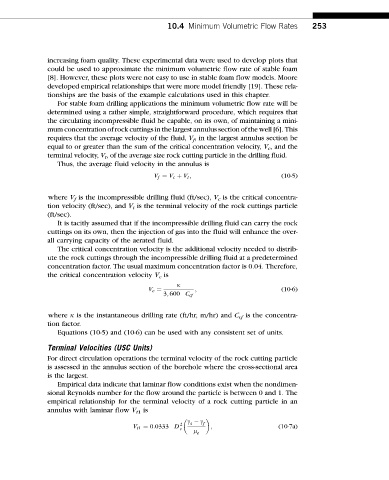
                 Thus, the average fluid velocity in the annulus is
                                            V f ¼ V c þ V t ;                  (10-5)


              where V f is the incompressible drilling fluid (ft/sec), V c is the critical concentra-
              tion velocity (ft/sec), and V t is the terminal velocity of the rock cuttings particle
              (ft/sec).
                 It is tacitly assumed that if the incompressible drilling fluid can carry the rock
              cuttings on its own, then the injection of gas into the fluid will enhance the over-
              all carrying capacity of the aerated fluid.
                 The critical concentration velocity is the additional velocity needed to distrib-
              ute the rock cuttings through the incompressible drilling fluid at a predetermined
              concentration factor. The usual maximum concentration factor is 0.04. Therefore,
              the critical concentration velocity V c is

                                                  k
                                          V c ¼        ;                       (10-6)
                                              3; 600 C cf
              where k is the instantaneous drilling rate (ft/hr, m/hr) and C cf is the concentra-
              tion factor.
                 Equations (10-5) and (10-6) can be used with any consistent set of units.


              Terminal Velocities (USC Units)
              For direct circulation operations the terminal velocity of the rock cutting particle
              is assessed in the annulus section of the borehole where the cross-sectional area
              is the largest.
                 Empirical data indicate that laminar flow conditions exist when the nondimen-
              sional Reynolds number for the flow around the particle is between 0 and 1. The
              empirical relationship for the terminal velocity of a rock cutting particle in an
              annulus with laminar flow V t1 is


                                                      s
                                                   2  g   g  f
                                      V t1 ¼ 0:0333 D      ;                  (10-7a)
                                                   c
                                                        e
                                                       m

