


Page 269 - Air and gas Drilling Field Guide 3rd Edition
P. 269
260     CHAPTER 10 Stable Foam Drilling


                                                       Pressure (Psia)
                                          400    600    800    1000   1200   1400
                                      −7000
                                                                               −2200
                                      −7500                       Bottom Hole Pressure  −2400
                                     Open Hole Depth Position (ft)  −8500      −2600  Open Hole Depth Position (m)
                                      −8000


                                      −9000
                                                                               −2800

                                                   Injection Pressure
                                      −9500
                                                                               −3000
                                     −10000
                                            320 400 480 560 640 720 800 880 960
                                                     Pressure (N/cm2 abs)


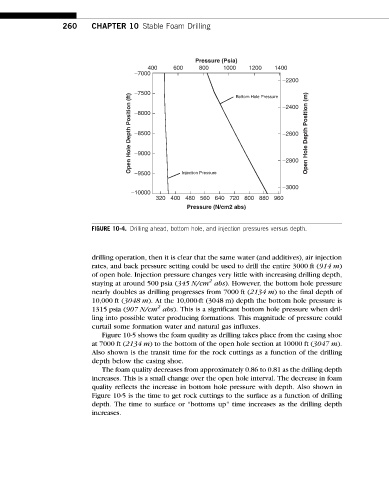
                          FIGURE 10-4. Drilling ahead, bottom hole, and injection pressures versus depth.


                          drilling operation, then it is clear that the same water (and additives), air injection
                          rates, and back pressure setting could be used to drill the entire 3000 ft (914 m)
                          of open hole. Injection pressure changes very little with increasing drilling depth,
                                                           2
                          staying at around 500 psia (345 N/cm abs). However, the bottom hole pressure
                          nearly doubles as drilling progresses from 7000 ft (2134 m) to the final depth of
                          10,000 ft (3048 m). At the 10,000-ft (3048 m) depth the bottom hole pressure is
                                             2
                          1315 psia (907 N/cm abs). This is a significant bottom hole pressure when dril-
                          ling into possible water producing formations. This magnitude of pressure could
                          curtail some formation water and natural gas influxes.
                             Figure 10-5 shows the foam quality as drilling takes place from the casing shoe
                          at 7000 ft (2134 m) to the bottom of the open hole section at 10000 ft (3047 m).
                          Also shown is the transit time for the rock cuttings as a function of the drilling
                          depth below the casing shoe.
                             The foam quality decreases from approximately 0.86 to 0.81 as the drilling depth
                          increases. This is a small change over the open hole interval. The decrease in foam
                          quality reflects the increase in bottom hole pressure with depth. Also shown in
                          Figure 10-5 is the time to get rock cuttings to the surface as a function of drilling
                          depth. The time to surface or “bottoms up” time increases as the drilling depth
                          increases.

