


Page 270 - Air and gas Drilling Field Guide 3rd Edition
P. 270
10.6 Conclusions     261


                                     Cuttings Time to Surface (min)
                             10       15        20       25        30
                         −7000
                                                                    −2200
                         −7500
                                               Time
                                                                    −2400
                         −8000
                        Depth (ft)  −8500                           −2600  Depth (m)


                         −9000
                                                                    −2800
                                               Foam Quality
                         −9500
                                                                    −3000
                        −10000
                             0.8   0.81  0.82  0.83   0.84  0.85  0.86
                                       Bottom Hole Foam Quality


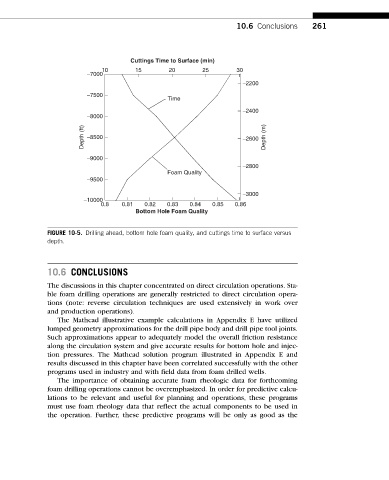
              FIGURE 10-5. Drilling ahead, bottom hole foam quality, and cuttings time to surface versus
              depth.


              10.6 CONCLUSIONS
              The discussions in this chapter concentrated on direct circulation operations. Sta-
              ble foam drilling operations are generally restricted to direct circulation opera-
              tions (note: reverse circulation techniques are used extensively in work over
              and production operations).
                 The Mathcad illustrative example calculations in Appendix E have utilized
              lumped geometry approximations for the drill pipe body and drill pipe tool joints.
              Such approximations appear to adequately model the overall friction resistance
              along the circulation system and give accurate results for bottom hole and injec-
              tion pressures. The Mathcad solution program illustrated in Appendix E and
              results discussed in this chapter have been correlated successfully with the other
              programs used in industry and with field data from foam drilled wells.
                 The importance of obtaining accurate foam rheologic data for forthcoming
              foam drilling operations cannot be overemphasized. In order for predictive calcu-
              lations to be relevant and useful for planning and operations, these programs
              must use foam rheology data that reflect the actual components to be used in
              the operation. Further, these predictive programs will be only as good as the

