


Page 268 - Air and gas Drilling Field Guide 3rd Edition
P. 268
10.5 Nonfriction and Friction Illustrative Examples  259


                                           Pressure (psia)
                             0      200    400    600    800    1000
                            0                                       0
                                     Back        Injection
                                     Pressure
                                                                    −500
                         −2000

                                                                    −1000
                         −4000                         Inside Drill String
                        Depth (ft)                                  −1500  Depth (m)


                         −6000      Annulus
                                                                    −2000
                                                               Bit
                         −8000
                                                                    −2500

                        −10000                                      −3000
                             0           500         1000         1500
                                                    2
                                         Pressure (N/cm  abs)

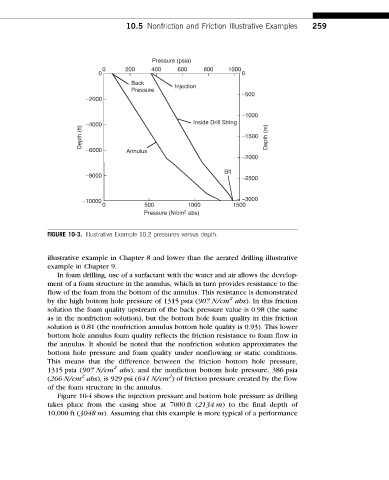
              FIGURE 10-3. Illustrative Example 10.2 pressures versus depth.


              illustrative example in Chapter 8 and lower than the aerated drilling illustrative
              example in Chapter 9.
                 In foam drilling, use of a surfactant with the water and air allows the develop-
              ment of a foam structure in the annulus, which in turn provides resistance to the
              flow of the foam from the bottom of the annulus. This resistance is demonstrated
                                                                 2
              by the high bottom hole pressure of 1315 psia (907 N/cm abs). In this friction
              solution the foam quality upstream of the back pressure value is 0.98 (the same
              as in the nonfriction solution), but the bottom hole foam quality in this friction
              solution is 0.81 (the nonfriction annulus bottom hole quality is 0.93). This lower
              bottom hole annulus foam quality reflects the friction resistance to foam flow in
              the annulus. It should be noted that the nonfriction solution approximates the
              bottom hole pressure and foam quality under nonflowing or static conditions.
              This means that the difference between the friction bottom hole pressure,
                                 2
              1315 psia (907 N/cm abs), and the nonfiction bottom hole pressure, 386 psia
                        2
                                                2
              (266 N/cm abs), is 929 psi (641 N/cm ) of friction pressure created by the flow
              of the foam structure in the annulus.
                 Figure 10-4 shows the injection pressure and bottom hole pressure as drilling
              takes place from the casing shoe at 7000 ft (2134 m) to the final depth of
              10,000 ft (3048 m). Assuming that this example is more typical of a performance

