


Page 336 -
P. 336
310 Chapter 8 ■ Classification
Any reasonable scheme for merging the results from multiple classifiers
must deal with three important issues:
1. The response of the multiple classifier must be the best one given
the results of the individual classifiers. It should in some logical way
represent the most likely true classification, even when presented with
contradictory individual classifications.
2. The classifiers in the system may produce different types of response.
These must be merged into a coherent single response.
3. The multiple classifier must yield the correct result more often than any
of the individual classifiers, or there is no point.
The first problem has various potential solutions for each possible type of
response, and these will be dealt with first.
8.5.2 Merging Type 1 Responses
Given that the output of each classifier is a single, simple classification value,
the obvious way to combine them is by using a voting strategy. A majority
voting scheme can be expressed as follows: let C i (x)be the result produced by
classifier i for the digit image x, where there are k different classifiers in the
system; then let H(d) be the number of classifiers giving a classification of d for
the digit image x,where d is one of {0,1,2,3,4,5,6,7,8,9}. H can be thought of as
a histogram, and could be calculated in the following manner:
for (i=0; i<k; i++)
H[ Ci(x) ] += 1;
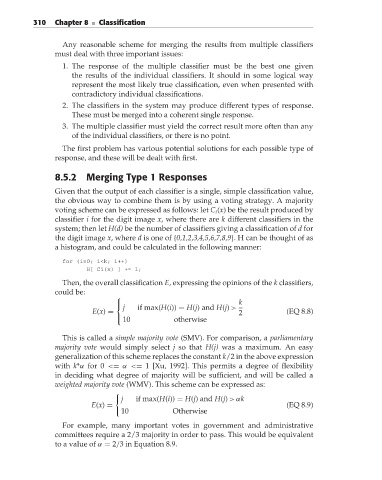
Then, the overall classification E, expressing the opinions of the k classifiers,
could be:
k
j if max(H(i)) = H(j)and H(j) >
E(x) = 2 (EQ 8.8)
10 otherwise
This is called a simple majority vote (SMV). For comparison, a parliamentary
majority vote would simply select j so that H(j) was a maximum. An easy
generalization of this scheme replaces the constant k/2 in the above expression
with k*α for 0 <= α<= 1 [Xu, 1992]. This permits a degree of flexibility
in deciding what degree of majority will be sufficient, and will be called a
weighted majority vote (WMV). This scheme can be expressed as:
*
j if max(H(i)) = H(j)and H(j) >αk
E(x) = (EQ 8.9)
10 Otherwise
For example, many important votes in government and administrative
committees require a 2/3 majority in order to pass. This would be equivalent
to a value of α = 2/3inEquation8.9.

