


Page 492 -
P. 492
472   CHAPTER 11 QUEUING MODELS


                                       6 The probability that an arriving unit has to wait for service:


                                                                      P w ¼                         (11:29)


                                     Note that the relationships for L, W q and W are the same as the relationships used for
                                     the models in Sections 11.2 and 11.3. They are given by Little’s flow equations.

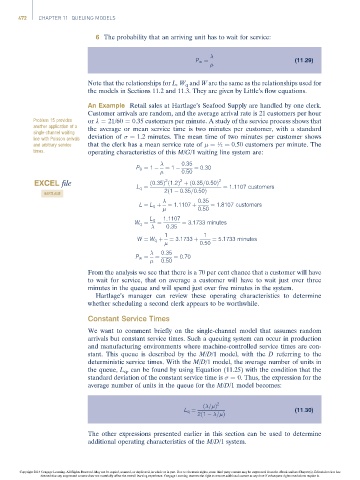
                                     An Example Retail sales at Hartlage’s Seafood Supply are handled by one clerk.
                                     Customer arrivals are random, and the average arrival rate is 21 customers per hour
                    Problem 15 provides  or l ¼ 21/60 ¼ 0.35 customers per minute. A study of the service process shows that
                    another application of a  the average or mean service time is two minutes per customer, with a standard
                    single-channel waiting
                    line with Poisson arrivals  deviation of   ¼ 1.2 minutes. The mean time of two minutes per customer shows
                    and arbitrary service  that the clerk has a mean service rate of   ¼ ½ ¼ 0:50 customers per minute. The
                    times.           operating characteristics of this M/G/1 waiting line system are:
                                                                 0:35
                                                   P 0 ¼ 1    ¼ 1    ¼ 0:30
                                                                 0:50
                                                            2
                                                                 2
                    EXCEL file                          ð0:35Þ ð1:2Þ þð0:35=0:50Þ 2
                                                    L q ¼                     ¼ 1:1107 customers
                                                            2ð1   0:35=0:50Þ
                       HARTLAGE
                                                                      0:35
                                                    L ¼ L q þ  ¼ 1:1107 þ  ¼ 1:8107 customers
                                                                      0:50
                                                        L q  1:1107
                                                   W q ¼  ¼      ¼ 3:1733 minutes
                                                             0:35
                                                            1           1
                                                    W ¼ W q þ  ¼ 3:1733 þ  ¼ 5:1733 minutes
                                                                       0:50
                                                           0:35
                                                   P w ¼  ¼    ¼ 0:70
                                                           0:50
                                     From the analysis we see that there is a 70 per cent chance that a customer will have
                                     to wait for service, that on average a customer will have to wait just over three
                                     minutes in the queue and will spend just over five minutes in the system.
                                       Hartlage’s manager can review these operating characteristics to determine
                                     whether scheduling a second clerk appears to be worthwhile.

                                     Constant Service Times
                                     We want to comment briefly on the single-channel model that assumes random
                                     arrivals but constant service times. Such a queuing system can occur in production
                                     and manufacturing environments where machine-controlled service times are con-
                                     stant. This queue is described by the M/D/1 model, with the D referring to the
                                     deterministic service times. With the M/D/1 model, the average number of units in
                                     the queue, L q , can be found by using Equation (11.25) with the condition that the
                                     standard deviation of the constant service time is   ¼ 0. Thus, the expression for the
                                     average number of units in the queue for the M/D/1 model becomes:


                                                                        ð = Þ 2
                                                                  L q ¼                             (11:30)
                                                                      2ð1    = Þ

                                     The other expressions presented earlier in this section can be used to determine
                                     additional operating characteristics of the M/D/1 system.


                Copyright 2014 Cengage Learning. All Rights Reserved. May not be copied, scanned, or duplicated, in whole or in part. Due to electronic rights, some third party content may be suppressed from the eBook and/or eChapter(s). Editorial review has
                      deemed that any suppressed content does not materially affect the overall learning experience. Cengage Learning reserves the right to remove additional content at any time if subsequent rights restrictions require it.

