


Page 368 - Analog and Digital Filter Design
P. 368
Introduction to Digital Filters   365


                      ing to the next input, the first output address is the input address plus one (unless
                      we are at the end of the memory space). All we have to do is continuously incre-
                      ment the output pointer, remembering to loop back to the bottom of the address
                      range once we have read from the highest address, and multiply the value stored
                      in that address by  the appropriate coefficient. All the coefficient multiplication
                      operations have to be carried out before the next input saniple is stored.


                Introduction to the Infinite Response Filter

                      The infinite response filter (IIR) uses a feedback loop, so the output at one clock
                      period somehow affects the output during the next period. This will have some
                      sort of  exponential effect, so that each output has a smaller effect on the next
                      output (otherwise the output would be unstable, if  you think about it).

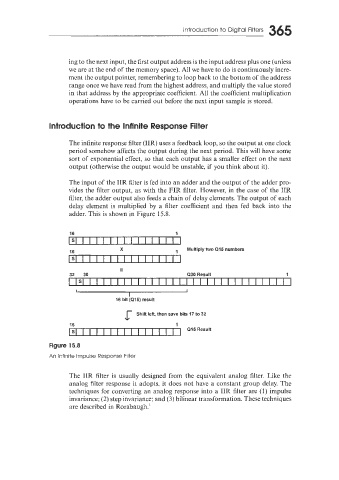
                      The input of the IIR filter is fed into an adder and the output of  the adder pro-
                      vides the filter output, as with the FIR filter. However, in the case of  the IIR
                      filter, the adder output also feeds a chain of delay elements. The output of each
                      delay element is multiplied by  a filter coefficient and then  fed  back  into the
                      adder. This is shown in Figure 15.8.


                                      It
                      32   30                             Q30 Result                    1
                        -I-
                                    16 bit (Ql5) result

                                           Shift left, then save bits 17 to 32
                      16                               1
                                                          Q15 Result

                Figure 15.8
                An Infinite Impulse Response Filter

                      The IIR filter is  usually designed from the equivalent analog filter. Like the
                      analog filter response it adopts, it does not have a constant group delay. The
                      techniques for converting an analog response into a IIR filter are (1) impulse
                      invariance; (2) step invariance; and (3) bilinear transformation. These techniques
                      are described in Rorabaugh.'

