


Page 366 - Analog and Digital Filter Design
P. 366
Introduction to Digital Filters  363


                      The frequency response of digital filters can therefore be mapped to a circle, so
                      as the frequency increases beyond half  the sampling rate it forms an alias with
                      the  next  harmonic.  This  process  continues  as  the  frequency  is  increased.
                      Opening out the circle gives a repeated pattern  of  frequency responses across
                      the  spectrum, each  pattern  centered on  zero  and  multiples  of  the  sampling
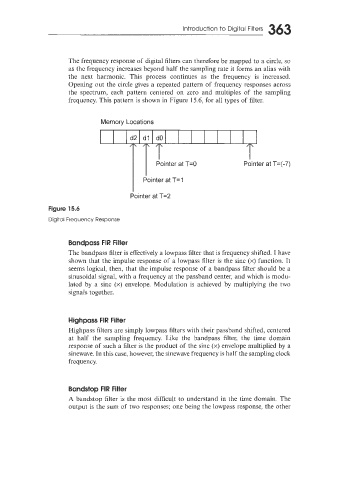
                      frequency. This pattern is shown in Figure 15.6, for all types of filter.


                                Memory Locations


                                         Pointer at T=2

                Figure 15.6
                Digital Frequency Response


                      Bandpass FIR Filter
                      The bandpass filter is effectively a lowpass filter that is frequency shifted. I have
                      shown that the impulse response of  a lowpass filter is the sinc (x) function. It
                      seems logical, then, that the impulse response of  a bandpass filter should be a
                      sinusoidal signal, with a frequency at the passband center, and which is modu-
                      lated by  a  sinc (x) envelope. Modulation  is  achieved by  multiplying the two
                      signals together.


                      Highpass FIR Filter
                        ighpass filters are simply lowpass filters with their passband shifted, centered
                      at  half  the  sampling frequency. Like  the  bandpass  filter, the  time  domain
                      response of  such a filter is the product of the sinc (x) envelope multiplied by a
                      sinewave. In this case, however, the sinewave frequency is half the sampling clock
                      frequency.


                      Bandstop FIR Filter
                      A bandstop filter is the most  difficult to understand in the time domain. The
                      output is the sum of  two responses; one being the lowpass response, the other

