


Page 364 - Analog and Digital Filter Design
P. 364
Introduction to Digital Filters


                      If  the folded FIR filter is  implemented in a digital signal processor (DSP). it
                      requires far less computational effort than the linear FIR filter. Summing cir-
                      cuits use little processor time, but multiplication requires a number of shift and
                      add operations. Also, reading the filter coefficients from memory takes time. The
                      processor is only required to read half  the coefficients in a folded FIR filter,

                      One advantage of the FIR filter, in either form, is that its output is linear phase.
                      It is linear phase because each input signal passes through all the delay elements,
                      so a slowly changing signal goes through the same processes as a rapidly chang-
                      ing signal; all frequencies are delayed equally. In other words the group delay is
                      constant and is proportional to the number of  delay elements in .the filter.


                Truncation (Applied to FIR Filters)

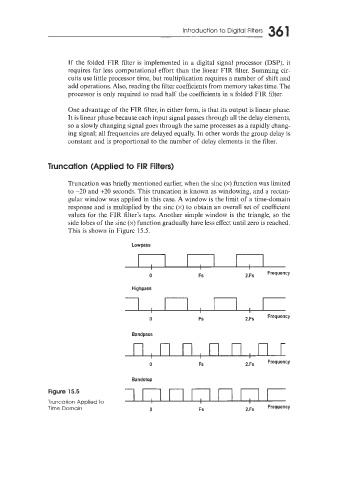
                      Truncation was briefly mentioned earlier, when the sinc (x) function was limited
                      to -30  and +20 seconds. This truncation is known as windowing, and a rectan-
                      gular window was applied in this case. A window is the limit of a time-domain
                      response and is multiplied by the sinc (x) to obtain an overall set of coefficient
                      values for the FIR filter’s taps. Another  simple window is the triangle, so the
                      side lobes of the sinc (x) function gradually have less effect until zero is reached.
                      This is shown in Figure 15.5.

                                         Lowpass


                                         Highpass


                                              0              Fs

                                         Bandpass


                                         Bandstop

                Figure 15.5
               Truncation Applied to
               Time Domain                    0              Fs

