


Page 361 - Analog and Digital Filter Design
P. 361
358 Analog and Digital Filter Design


                                                 BRICK WALL  RESPONSE


                                                                   FREQUENCY


                                               W
                                               I-
                                               1 0.5
                                               n
                 Figure  15.2                  E   O
                 The Brick Wall Filter: Time and   a 4.5
                 Frequency Domains                                          TI ME

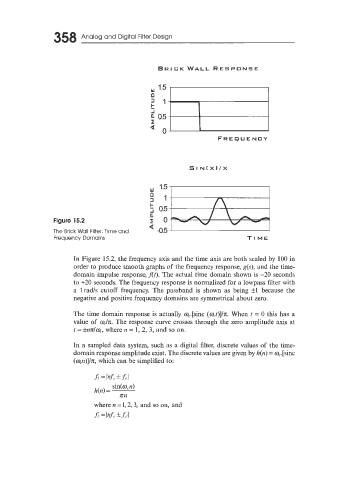
                       In Figure 15.2, the frequency axis and the time axis are both scaled by  100 in
                       order to produce smooth graphs of the frequency response, g(s), and the time-
                       domain impulse response,  fit).  The actual time domain shown is -20  seconds
                       to +20 seconds. The frequency response is normalized for a lowpass filter with
                       a  lrad/s cutoff  frequency. The passband  is  shown as being fl because  the
                       negative and positive frequency domains are symmetrical about zero.

                       The time domain response is actually w,.[sinc  (act)]/n. When t = 0 this has a
                       value of  wJn. The response curve crosses through the zero amplitude axis at
                       t = kndm,, where n = 1, 2, 3, and so on.

                       In a sampled data system, such as a digital filter, discrete values of  the time-
                       domain response amplitude exist. The discrete values are given by h(n) = w,.[sinc
                       (wp)]/n, which can be simplified to:


                                   sin(w,.rz)
                              h(n) =
                                     zn
                                   ~
                              where n = 1,2,3,  and so on, and
                              fl = IM * Ll

