


Page 358 - Analog and Digital Filter Design
P. 358
Introduction to Digitcl Filters   35


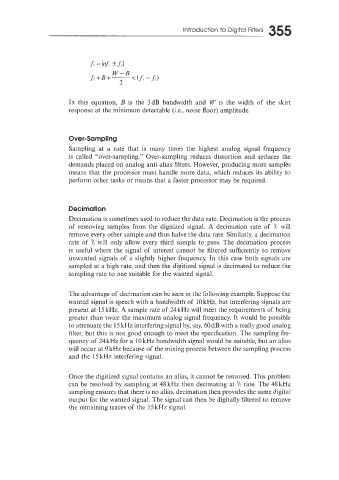
                      In  this  equation,  B  is  the  3dB bandwidth  and  61‘  is  the  width  of  the  skirt
                      response at the minimum detectable (i.e., noise floor) amplitude.


                      Over-Sampling
                      Sampling  at  a  rate  that  is  many  times  the  highest  analog  signal  frequency
                      is  called  “over-sampling.’’ Over-sampling  reduces  distortion  and  reduces  the
                      demands placed on analog anti-alias filters. However, producing more samples
                      means that  the processor  must  handle more data, which reduces its ability to
                      perform other tasks or means that a faster processor may be required.


                      Decimation
                      Decimation is sometimes used to reduce the data rate. Decimation is the process
                      of  removing  samples  from  the  digitized  signal.  A  decimation  rate  of  ‘/2  will
                      remove every other sample and thus halve the data rate. Similarly. a decimation
                      rate of  $ will  only allow every third sample to pass.  The decimation process
                      is useful where the signal of  interest  cannot  be filtered sufficiently to  remove
                      unwanted  signals of  a  slightly higher  frequency. In this case both signals are
                      sampled at a high rate, and then the digitized signal is decimated to reduce the
                      sampling rate to one suitable for the wanted signal.


                      The advantage of decimation can be seen in the following example. Suppose the
                      wanted signal is speech with a bandwidth of  lOkHz, but interfering signals are
                      present at 15 kHz. A sample rate of  24 kHz will meet the requirements of being
                      greater than twice the maximum analog signal frequency. It would be possible
                      to attenuate the 15 kHz interfering signal by, say, 60dB with a really good anaiog
                      filter, but  this is not good enough to meet the specification. The sampling fre-
                      quency of  24kHz for a IOkHz bandwidth signal would be suitable, but an alias
                      will occur at 9 kHz because of the mixing process between the sampling process
                      and the 15 kHz interfering signal.


                      Once the digitized signal contains an alias, it cannot be removed. This problem
                      can be resolved by  sampling at 48 kHz then decimating at  ‘12 rate. The 48 kHz
                      sampling ensures that there is no alias, decimation then provides the same digital
                      output for the wanted signal. The signal can then be digitally filtered to remove
                      the remaining traces of the 15 kHz signal.

