


Page 353 - Analog and Digital Filter Design
P. 353
350 Analog and Digital Filter Design


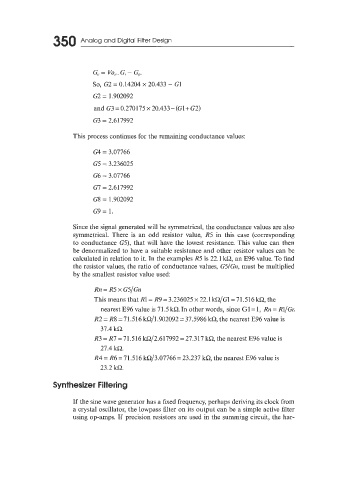
                                      G,
                             G,, = VO,~. - G,.
                             SO, G2 = 0.14204 x 20.433 - GI

                             G2 = 1.902092
                                                           G2)
                              and G3 = 0.2701 75 x 20.433 - (G1 i-
                             G3 = 2.617992

                       This process continues for the remaining conductance values:

                             G4 = 3.07766
                             G5 = 3.236025

                             G6 = 3.07766
                             G7 = 2.617992
                             G8 = 1.902092
                             G9= 1.

                       Since the signal generated will be symmetrical, the conductance values are also
                       symmetrical. There is  an odd  resistor value,  R5 in  this case (corresponding
                       to conductance G5), that will  have the lowest resistance. This value can then
                       be denormalized to have a suitable resistance and other resistor values can be
                       calculated in relation to it. In the examples R5 is 22.1 kQ, an E96 value. To find
                       the resistor values, the ratio of conductance values, G5/G?z, must be multiplied
                       by the smallest resistor value used:

                              Rn = R5 x G5/Gn
                              This means that R1= R9 = 3.236025 x 22.1 kQ/Gl= 71.516 kQ, the
                                nearest E96 value is 71.5 kQ. In other words, since GI=l, Rn = Rl/Gfi
                              R2 = R8 = 71.516 k0/1.902092 = 37.5986 kQ, the nearest E96 value is
                                37.4 kQ.
                              R3 = R7 = 71.516 kQl2.617992 = 27.317 k0, the nearest E96 value is
                                27.4 kQ.
                              R4 = R6 = 71.516 kQ/3.07766=  23.237 kQ, the nearest E96 value is
                                23.2 kQ.

                 Synthesizer Filtering

                       If  the sine wave generator has a fixed frequency, perhaps deriving its clock from
                       a crystal oscillator, the lowpass filter on its output can be a simple active filter
                       using op-amps. If  precision resistors are used in the summing circuit, the har-

