


Page 360 - Analog and Digital Filter Design
P. 360
Introduction to Digital Filters   357


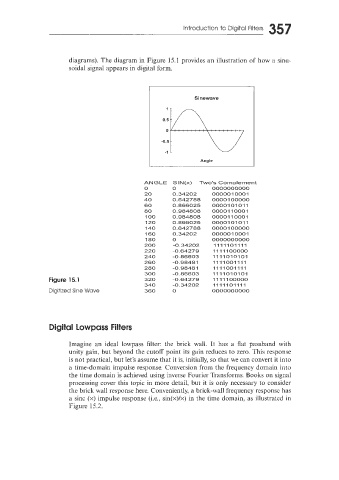
                      diagrams). The diagram in Figure  15.1 provides an illustration of  how a sinu-
                      soidal signal appears in digital form.


                                                            Sinewave


                                              I               Angle


                                             ANGLE  SIN(x)    Two's Corndement
                                                         ..
                                             0       0           0000000000
                                             20       0.34202    000001 0001
                                             40      0.642788  00001 00000
                                             60      0.866025  00001 01 03 1
                                             80      0.984808  0000170001
                                             100     0.984808  00001 10001
                                             120     0.866025  00001 01 01 1
                                             140     0.642788  00001  00000
                                             160      0.34202    000001 0001
                                             180      0          0000000000
                                             200      -0.34202  11111011 11
                                             220     -0.64279  11 111  00000
                                             240     -0.86603  111101 0101
                                             260     -0.9848      1 11 I 001 11 1
                                                             1
                                             280     -0.9848      11 11 001 17 1
                                                             1
                                             300     -0.86603  11 11 010101
                Figure  15.1                 320     -0.64279     11 11  100000
                                             340     -0.34202     1111101111
                Digitized Sine Wave          360      0          0000000000


                Digital Lowpass Filters

                      Imagine  an  ideal  lowpass filter:  the  brick  wall.  It  has  a  flat  passband  with
                      unity gain, but beyond the cutoff point  its gain reduces to zero. This response
                      is not practical, but let's assume that it is, initially, so that we can convert it into
                      a time-domain impulse response. Conversion from the frequency domain into
                      the time domain is achieved using inverse Fourier Transforms. Books on signal
                      processing cover this topic in more detail, but  it is only necessary to consider
                      the brick wall response here. Conveniently, a brick-wall frequency response has
                      a sinc (x) impulse response (i.e., sin(x)/x) in the time domain, as illustrated in
                      Figure 15.2.

